Home·
Sezioni

Alfredo Bennicelli

Alfredo Bennicelli e la nascita incompiuta del carrismo italiano
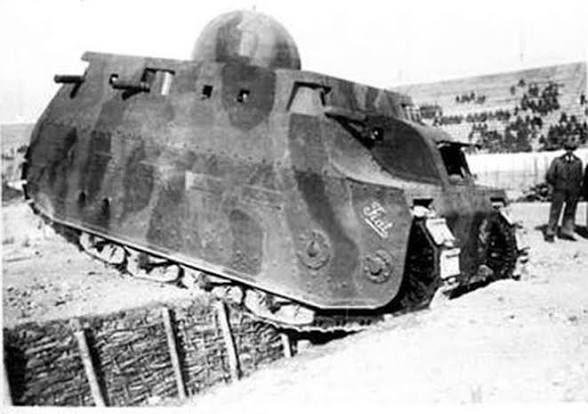
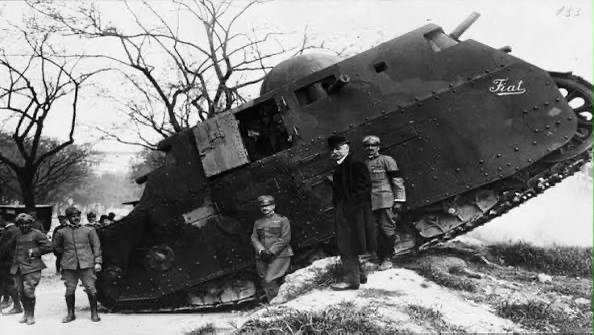
Il carro Fiat 2000 in dimostrazione pubblica, con il portello aperto
Fiat 2000 in dimostrazione pubblica, portello aperto davanti alla folla. Archivio Famiglia Bennicelli.

1. Un pioniere

Nella storia militare italiana del Novecento ci sono uomini che cambiano il modo in cui un esercito dovrebbe pensare le battaglie. Il conte Alfredo Bennicelli appartiene a questo secondo gruppo. Ufficiale di artiglieria di complemento, meccanico per vocazione, agricoltore di grandi tenute, osservatore sul fronte occidentale, poi tenente colonnello, colonnello della riserva, generale di brigata, senatore del Regno e segretario pontificio per le Ambasciate, è ricordato dalla storiografia della specialità come il primo ufficiale italiano incaricato in modo organico di studiare il carro armato e, idealmente, come fondatore dei carristi.

La sua vicenda non è soltanto una biografia. È la storia di una lungimiranza che, tra il 1917 e i primi anni Venti, si scontrò con la cautela finanziaria, la gelosia dei corpi tradizionali e una cultura strategica ancora inchiodata alle Alpi e alla fanteria. Quel contrasto, documentato dalle cronache associative dei carristi e dalle voci sulla nascita della specialità, avrebbe pesato a lungo sulla motorizzazione dell’esercito.

Lo storico Mario Picone Chiodo, in “In nome della resa” (Milano, Mursia, 1987), lo scrisse senza giri di parole: l’unica persona che in Italia capì l’importanza del carro fu il conte Alfredo Bennicelli, responsabile dell’ufficio carri d’assalto presso il Commissariato per le armi e munizioni. Avrebbe voluto approfondire gli studi dopo il conflitto, ma fu dissuaso da un governo che temeva macchine così vistose come provocazione all’ordine sociale, e «neutralizzato del tutto» con la nomina a senatore nel 1934.

2. Una vocazione tecnica prima che militare

Alfredo Bennicelli nacque a Roma il 19 febbraio 1879, figlio primogenito del conte Achille e di Elisabetta Martinori. La scheda del Senato registra i fratelli Filippo, Riccardo e Maria Antonietta.

Apparteneva a una famiglia romana ricca e legata alla Corte pontificia, che servì senza interruzione sette papi, da Pio IX a Paolo VI.

Crebbe a Roma, studiò in un collegio di Firenze e proseguì all’Università di Agraria.

Imparò francese e inglese, lingue che gli sarebbero servite nelle missioni alleate. Sin da giovane si appassionò alla meccanica e alla meccanizzazione dell’agricoltura.

A diciotto anni ottenne l’autorizzazione a guidare automobili: la famiglia fu tra le prime in Italia a possederne una. A ventisei entrò in possesso della sua prima vettura, una Benz del 1905, che — come tutte le successive, e come orologi e altri meccanismi — riparava e metteva a punto da solo.

All’inizio del Novecento svolse il servizio di leva come sottotenente di complemento nel 13º Reggimento artiglieria da campagna a Roma. Era tradizione di famiglia: buona parte dei Bennicelli passava per una specialità dell’artiglieria. Non era un ufficiale di carriera nel senso stretto.

Congedato, si dedicò alla cura delle sue aziende agricole nel Lazio e in Umbria, oltre cinquemila ettari, migliorandone la conduzione e avviandone la meccanizzazione.

Sposò Rosanna dei marchesi Spinola. Dal matrimonio nacque Alberto.

Il pro-nipote Filippo, intervistato da La Stampa nel 2017, lo avrebbe ricordato come «un gigante che ci aiutava a riparare i nostri giocattoli», figura autorevole e insieme «dotata di una particolare dolcezza» con i bambini. L’immagine non è d’appendice: dice di un uomo capace di tenere insieme officina e famiglia.

Scheda anagrafica e istituzionale

Voce Dato
Nascita / morte Roma, 19 febbraio 1879 – Roma, 30 maggio 1960
Genitori Achille Bennicelli ed Elisabetta Martinori
Fratelli Filippo; Maria Antonietta; Riccardo, caduto a Tolmino nel 1917
Coniuge e figlio Rosanna dei marchesi Spinola; Alberto Bennicelli Bonini
Residenza senatoriale Via di Villa Albani 14-16, Roma
Grado Da sottotenente di complemento a generale di brigata della riserva (1940)
Cariche civili Industriale-agricoltore; presidente della Cattedra ambulante di agricoltura di Perugia; senatore dal 23 gennaio 1934; dal 1950 segretario pontificio per le Ambasciate
Tenute Oltre 5.000 ettari nel Lazio e in Umbria

3. Requisizioni, Fiat e il preludio del carro

Con l’entrata in guerra dell’Italia, il 24 maggio 1915, fu richiamato e assegnato all’ufficio di requisizione degli automezzi da destinare all’impiego militare. Dapprima ebbe autorità sulle province di Roma, Terni e Perugia; poi anche su Piemonte, Lombardia e Veneto. Si fece notare per la competenza meccanica e fu destinato alla Fiat di Torino, dove organizzò riparazione e conversione dei mezzi danneggiati e sorvegliò la costruzione di auto e autocarri a caratteristiche militari.

Seguì, in particolare, la messa a punto dei veicoli per il traino dell’artiglieria pesante: Fiat 20B, Fiat 30, Pavesi-Tolotti A e B, con attenzione all’uso su strade di montagna, proprie del fronte italiano. Il lavoro non si limitò al reperimento.

Formò «autieri esperti» e raccolse dai reparti e dai depositi le modifiche da introdurre in produzione. Le visite al fronte furono intense e continue. Questo impegno gli fruttò la promozione a capitano.

Quel passaggio a Torino è il vero preludio del carrismo italiano. Bennicelli imparò a ragionare in termini di motori, logistica, usura e industria, non solo di tattiche da manuale. Quando il Ministero della Guerra decise di indagare l’arma nuova comparsa sul fronte occidentale, aveva già l’uomo adatto.
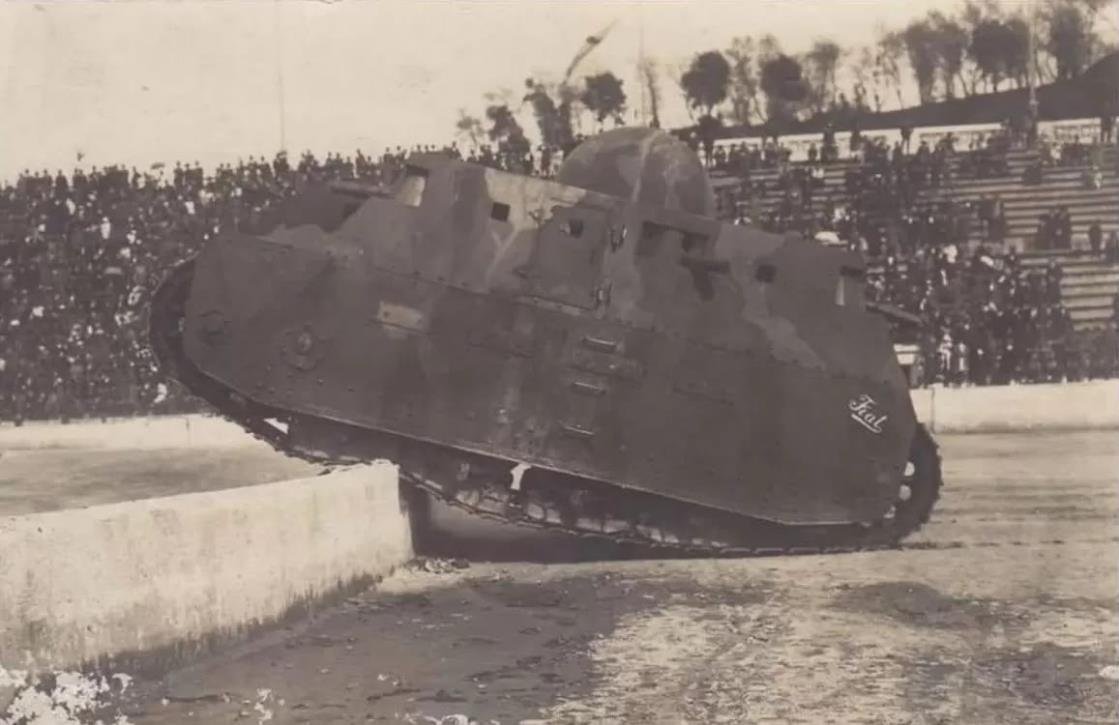
Il carro Fiat 2000 durante una dimostrazione pubblica, con il pubblico sullo sfondo
Altra foto del Fiat 2000 in dimostrazione pubblica. Archivio Famiglia Bennicelli.

4. Nelle Fiandre: vedere il futuro nel fango

L’interesse italiano per i carri nacque tardi e con prudenza. I primi tank britannici Mark I comparvero sulla Somme il 15 settembre 1916.

Il Regio Esercito, secondo la ricostruzione consolidata nella voce dedicata al carrista e nella cronistoria di Maurizio Parri, si avvicinò al mezzo «con molta cautela»: costi enormi, addestramento specifico, assenza di specialisti di logistica e manutenzione, mancanza di una dottrina d’impiego e «una diffusa diffidenza circa le loro reali possibilità d’affermarsi sul campo di battaglia».

Con l’apparire in Francia e in Gran Bretagna delle prime macchine corazzate, il 2 gennaio 1917 il Ministero della Guerra rilasciò ad Alfredo Bennicelli un passaporto diplomatico per la Francia, dove si stavano costituendo i primi nuclei di carri. L’incarico venne direttamente dal ministro, tenente generale Vittorio Italico Zupelli. Bennicelli scrisse nei rapporti che l’adozione di quelle «formidabili macchine» avrebbe potuto aiutare a superare l’immobilismo del fronte occidentale.

Tramite il generale Alfredo Dallolio, a capo della commissione franco-italiana, visitò gli stabilimenti Schneider, il Gran Quartier Général di Bragance e il centro di formazione di Marly.

Incontrò i generali francesi Estienne e Dupont per trattare la cessione di un carro Schneider al Regio Esercito. Fra intoppi e ostacoli, e grazie all’impegno personale dell’ambasciatore a Parigi, marchese Salvago Raggi, riuscì a esaminare i tank francesi e britannici schierati sul fronte di Ypres.

La memoria familiare fissa un episodio che le sintesi aperte formulano in modo diverso: il 17 agosto 1917, primo e a quanto si sa unico italiano, partecipò a un attacco a fuoco a Poperinge, pilotando personalmente un Renault FT.

In quell’occasione Bennicelli provò più volte i carri francesi in combattimento e si convinse che il tank più adatto al Regio Esercito sarebbe stato lo Schneider.

La voce enciclopedica sposta l’attacco britannico al 9 agosto 1917 e colloca l’ammirazione per lo Schneider in una successiva partecipazione francese sulla Somme.

Le due versioni vanno tenute distinte: la cronologia della memoria è coerente con il passaporto del gennaio 1917 e con un’azione nelle Fiandre nell’estate; l’attribuzione alla Somme, ripetuta anche da La Stampa nel 2017, è incompatibile con il debutto dei carri su quel fiume, avvenuto nel settembre 1916, prima della sua missione.

Studiò anche un A7V tedesco catturato e non ne restò impressionato.
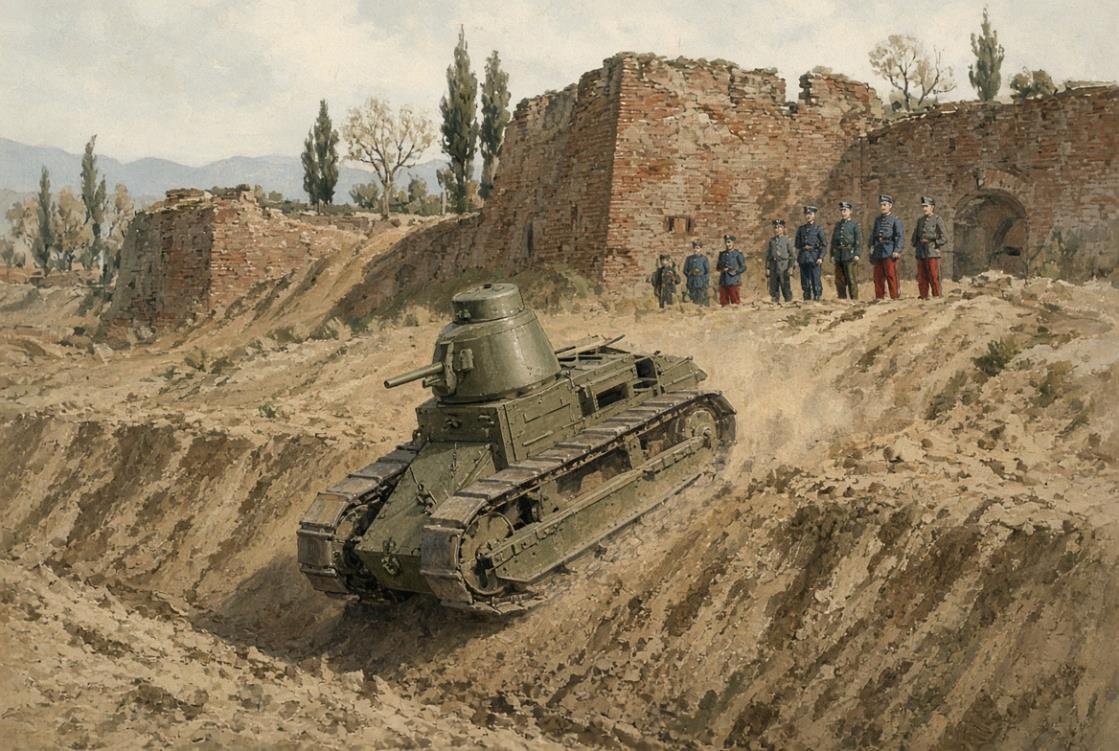
Ricostruzione illustrata di un carro Renault FT in azione dimostrativa davanti ad antiche mura
Ricostruzione ipotetica di un Renault FT in azione dimostrativa.

Dalla missione ottenne un risultato concreto e raro: uno Schneider, matricola 212, trasferito in Italia per le valutazioni. Le prove, a Tricesimo, diedero esito positivo: i cingoli funzionavano anche sul terreno italiano, almeno in linea di principio. L’Italia chiese allora altri mezzi. La relazione inoltrata indusse Dallolio a ordinare alla Francia 100 Renault FT e 20 Schneider CA1.
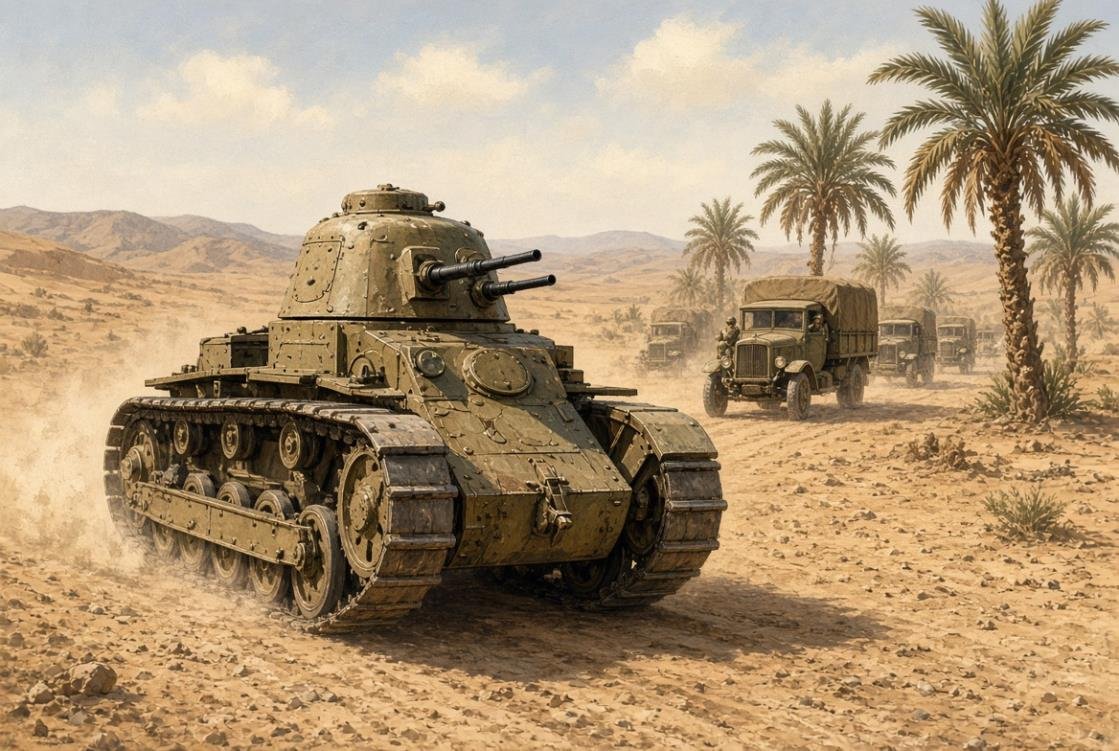
Ricostruzione illustrata di un carro Renault FT in azione su terreno desertico, con autocarri e palme
Ricostruzione ipotetica del Renault FT in azione.

Diplomazia dei mezzi

Il 10 ottobre 1917 gli fu rilasciato un nuovo passaporto diplomatico. Con l’ingegnere tenente Pasqualini tornò in Francia per trattare la fornitura, o in subordine la produzione su licenza. Visitarono fabbriche d’armamento e campi prova di Renault e Peugeot, annotando pregi e difetti. In questa missione Bennicelli fu promosso maggiore e approfondì le entrature negli eserciti francese e britannico, fra industriali, tecnici, politici e uomini di Stato.

La situazione militare degli alleati non era brillante: tedeschi e austro-ungarici avanzavano, e Francia e Gran Bretagna negarono le forniture all’Italia per riservarle ai propri eserciti. Con una mediazione ostinata, e nonostante la resistenza francese, ottenne comunque quattro Renault FT, da valutare in Italia in vista di una produzione nazionale.

La Stampa, nel 2017, riassume l’esito con una formula secca: su una richiesta dell’ordine di oltre un centinaio di carri — la memoria parla di cento FT e venti Schneider — i «cugini d’oltralpe» furono «avarissimi».

Giunse, nel frattempo, a Bennicelli la notizia che il fratello Riccardo, capitano di artiglieria decorato di tre medaglie d’argento al valor militare, sul fronte del Tolmino, era stato ucciso da un cecchino durante una ricognizione, a due giorni dalla grande offensiva austro-ungarica di Caporetto.

Per Alfredo la perdita fu un dolore terribile. Anni dopo fece costruire a sue spese, nella tenuta di Solfagnano in Umbria, una scuola elementare intitolata al fratello. In una fotografia delle prove del Fiat 2000, di seguito mostrata, compare con la fascia di lutto al braccio.

Il punto va tenuto fermo. Bennicelli non inventò il carro italiano in laboratorio: lo vide in guerra, ne misurò i limiti, capì che l’Italia non poteva dipendere dagli alleati e spinse l’industria nazionale a produrre in proprio. Alla fine del 1918, secondo Parri, sul suolo italiano c’erano in tutto sette carri: due Fiat 2000, uno Schneider e quattro Renault FT. Era il patrimonio minimo da cui sarebbe dovuto partire un esercito moderno. Non partì.

Churchill, la Legion d’onore, i Mark IV

Il 28 luglio 1918 un telegramma del ministro Zupelli al generale Nicolis di Robilant, capo della delegazione italiana a Versailles, informava che l’Italia era disposta a produrre l’FT anche per l’alleato francese. In cambio, per richiesta diretta del generale Armando Diaz al generalissimo Foch, si chiedeva l’immediata fornitura di «almeno» venticinque tank per le imminenti offensive a sorpresa sul fronte italiano, e alcuni Schneider medi modificati.

La missione continuò con incontri ad alto livello. Il 15 agosto, all’hotel Ritz di Parigi, Bennicelli vide Winston Churchill, allora ministro britannico delle Munizioni, dopo che nel luglio 1917 aveva assunto quel dicastero e dopo aver sostenuto il Landships Committee da cui erano nati i primi tank.

Il telegramma d’archivio, qui riprodotto, è un invito a cena alle ore 20.
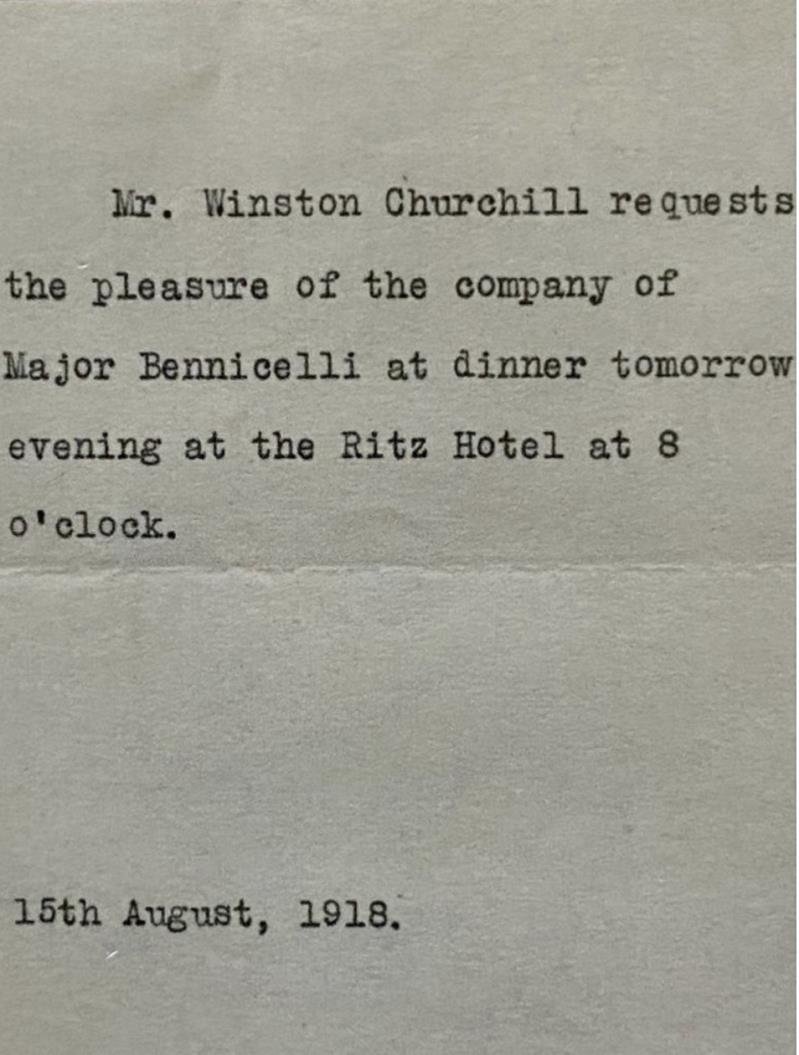
Biglietto dattiloscritto di invito di Winston Churchill al maggiore Bennicelli per una cena al Ritz Hotel, 15 agosto 1918
Invito di Winston Churchill a Major Bennicelli per una cena al Ritz Hotel, 15 agosto 1918. Archivio Famiglia Bennicelli.

In settembre il Ministero per gli Armamenti francese dispose la nomina del maggiore a cavaliere della Legion d’onore e la concessione della Croix de guerre con palme, per il coraggio dimostrato al fronte alla guida di carri e per l’impegno a difendere in Italia l’uso dei tank.

In ottobre Churchill valutò personalmente la possibilità di fornire all’Italia cinquanta Mark IV e di inviare al più presto personale italiano in Francia per istruirsi.

A queste onorificenze alleate la memoria aggiunge la Croix de guerre belga, la Distinguished Service Cross britannica e una citazione all’ordine dell’armata francese firmata da Pétain.

5. Due idee di carro, una sola industria
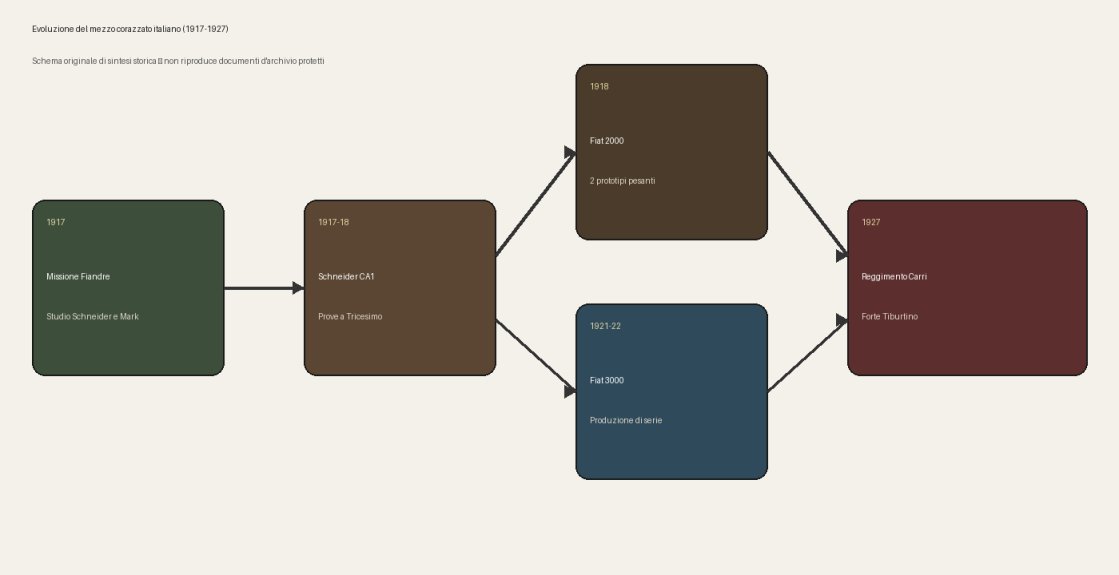
Schema dell’evoluzione del mezzo corazzato italiano 1917-1927: missione Fiandre, Schneider CA1, Fiat 2000, Fiat 3000, Reggimento Carri
Schema di sintesi 1917-1927, tavola di corredo del saggio.

5.1 Il Fiat 2000: fortezza mobile e vicolo cieco

L’Italia aveva avviato gli studi nel 1916, quando nel paese si ignoravano ancora i progetti francesi e britannici. Tra il 1916 e il 1918 la Fiat, su un impulso già aperto da un contratto del 1915 e con il contributo progettuale di Giulio Cesare Cappa e Carlo Cavalli, realizzò il primo carro pesante interamente italiano.

Il prototipo fu presentato alle autorità il 21 giugno 1917: la meccanica era definitiva, corazza e armamento vennero dopo, insieme alle prove presso Torino. Ne furono costruiti due soli esemplari, uno nel 1917 e uno nel 1918.

Nell’aprile 1918 il maggiore Bennicelli fu inviato a Treviso, sul Campo Esperienze Z, per assistere ai primi collaudi e per una relazione tecnica fondata su quanto aveva visto in Francia.

Scriveva che il grande tank era stato pensato per «costruire una macchina blindata con trasmissione a cingoli, potentemente armata e blindata, che potesse con facilità manovrare sui terreni pietrosi del Carso, quale base di numerosa squadriglia di altre macchine, più leggere e rapide». Elogiava la struttura meccanica, l’armamento e la blindatura realizzata dall’Ansaldo di Genova-Sampierdarena, la capacità di attraversare fiumi, abbattere ostacoli e superare trincee.

Dall’altra parte indicava i problemi aperti: mitragliatrici da montare su supporti sferici; un solo portello di uscita per l’equipaggio; impossibilità di usare il cannone con un forte angolo di depressione, dunque inutilizzabile nello scontro ravvicinato; dimensioni che impedivano il trasporto ferroviario senza smontare il carro in due parti; blindature, armi di bordo e linee di tiro non ancora collaudate, per stessa ammissione della Fiat.

Suggerì cariche di lancio ridotte per il cannone da 65 mm. Nelle discussioni sull’armamento spinse anche per un pezzo da 75/76 mm in torretta; prevalse il 65/17 da montagna.

Per l’epoca non era un mezzo rozzo. Era un colosso di circa 40 tonnellate — le schede tecniche parlano di 38,78 t, lungo 7,40 m, largo 3,20, alto 3,80 — con corazza da 15-20 mm, motore aeronautico Fiat A12 a sei cilindri di circa 250 CV (alcune cronache associative dicono per errore 600), velocità sui 6-7,5 km/h, equipaggio di 8-10 uomini, cannone o obice da 65/17 in torretta girevole e una corona di mitragliatrici Fiat-Revelli.

La Tank Encyclopedia lo descrive come un pesante ben concepito, con vano motore distinto dal compartimento di combattimento e una torretta apicale che anticipava soluzioni destinate a diventare canoniche.
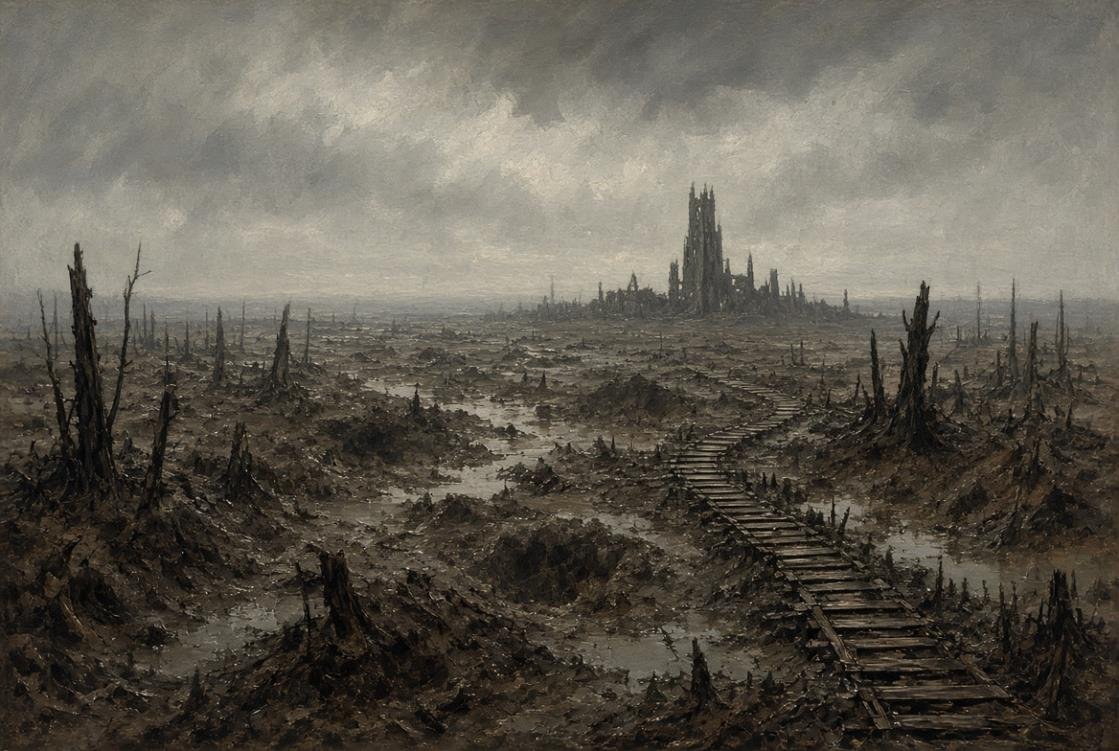
Ricostruzione illustrata di un paesaggio devastato delle Fiandre durante la prima guerra mondiale
Paesaggio ipotetico delle Fiandre durante la prima guerra mondiale.
Alfredo Bennicelli accanto al Fiat 2000 durante una dimostrazione
Alfredo Bennicelli durante una dimostrazione del FIAT 2000 con il lutto al braccio.

Il destino operativo confermò i dubbi sulla mobilità.

Su suggerimento di Bennicelli, il solo superiore che lo seguì — il generale Zupelli — si adoperò con il ministro delle Colonie. L’assenso arrivò: due Renault FT e uno dei due Fiat 2000 partirono per Tripoli. I mezzi giunsero nel febbraio 1919. Gli esperimenti libici furono interessanti.

I tank si spostavano su terreni sabbiosi e pietrosi, ma erano eccessivamente lenti: la lentezza era già stata segnalata da Bennicelli, che aveva fatto studiare carri capaci di una velocità doppia e di un armamento più potente.

L’effetto psicologico contro la guerriglia fu forte; la capacità di inseguire formazioni rapide nel deserto, no. Le tracce dell’esemplare africano si persero. Il secondo restò in Italia per le dimostrazioni, fu modificato nel 1934 con cannoncini Vickers-Terni 37/40 al posto di due mitragliatrici anteriori, esibito il 3 settembre 1934 al Campo Dux ai Parioli, finì come monumento nella caserma Corrado Mazzoni di Bologna, sede del 3º Reggimento fanteria corazzato, ed è attestato ancora nel 1936. Fu poi smantellato. Nessun Fiat 2000 originale sopravvive.

5.2 Il Renault FT e la via del carro leggero

Consapevoli che il 2000 era troppo lento e ingombrante, progettisti e comandi si orientarono sul Renault. Per accrescere l’interesse di forze armate, politica, industria e stampa, Bennicelli organizzò in breve una dimostrazione. Il 2 agosto, come riporta la Tank Encyclopedia, i quattro Renault FT giunti, entro maggio, erano pronti per il comando.

Sostanza dell’esibizione, sugli spalti delle antiche mura di Piacenza: sotto la guida di Bennicelli un FT superò forti dislivelli e trincee, un fossato largo 5 metri e profondo 2, cumuli di sabbia e grandi massi, un’automobile, e valicò un argine di 4,5 metri.

L’esibizione convinse. La Commissione Armi e Munizioni emise un ordine di 1.400 Renault FT da prodursi in Italia. La sera stessa, munito delle credenziali, partì per Parigi con l’ordine di trattare la licenza.

Il 25 settembre Fiat e Ansaldo gli comunicarono di aver organizzato la prossima produzione di 400 carri d’assalto, modificati secondo le sue indicazioni per superare corsi d’acqua profondi 1,20 metri.

In ottobre preparò un bilancio preventivo per 1.400 carri, suddivisi in lotti tra costruttori e da consegnare nei primi sei mesi del 1919. Con essi: 60 carri radio («carri d’assalto con telegrafo senza fili»), 150 rimorchi per il trasporto su strada, 100 autocarri da 7 tonnellate, cannoncini da 37 mm, mitragliatrici e il tipo di proiettili necessari.

Nello stesso 1918 preparò lo studio tecnico Artiglieria e carri blindati cingolati, che prevedeva la trasformazione degli FT in semoventi per cannoni da 75 e 105 mm, con la sola asportazione della torretta e di poche altre parti.

Uno di questi semoventi fu realizzato, subito dopo la fine del conflitto, dall’Ansaldo di Genova. Sarebbe comparso allo Stadio Nazionale.

Nacque comunque il Fiat 3000, primo carro italiano di serie: circa 150 esemplari tra il Modello 21, a mitragliatrici, e il Modello 30, con cannone da 37/40, più veloce dell’FT grazie a un motore Fiat da 50 CV e a soluzioni nazionali.

Entrò in servizio nel 1921-22 e restò in linea, incredibilmente, fino al 1943.

Fu la spina dorsale dei primi battaglioni. Combatté in Libia a Giarabub nel 1926, in Etiopia e, ormai obsoleto, sul fronte greco-albanese e in Sicilia, dove alcuni esemplari furono usati come fortini fissi.

Era il massimo che l’Italia avesse saputo derivare dalla spinta del 1917-18. Non era ancora una forza corazzata autonoma.

Confronto sintetico

Voce Fiat 2000 Fiat 3000
Anni ed esemplari 1917-1918, 2 esemplari 1921-1930 circa, circa 150
Peso circa 40 t (38,78 t in scheda) circa 5,5-6 t
Motore Fiat A12, circa 250 CV Fiat 4 cilindri, 50-63 CV
Velocità 6-7,5 km/h fino a circa 21 km/h
Armamento 65/17 in torretta e 7 mitragliatrici 2 mitr. 6,5 (Mod. 21) o 37/40 (Mod. 30)
Ruolo pensato Fortezza mobile, base di una squadriglia leggera Carro d’assalto leggero di serie
Destino Libia, parate, monumento, smantellato Libia, Etiopia, Grecia, Sicilia 1943

6. La fine della guerra e il bilancio del 27 dicembre

La grande offensiva italiana e alleata sul Piave, e la capitolazione delle armate austro-ungariche, chiusero la guerra sul fronte italiano.

Di lì a poco capitolò anche l’Impero germanico. Nel giro di pochi giorni, per disposizione del rettore del Commissariato Armi e Munizioni, S.E. Conti, la costruzione dei 1.400 carri fu sospesa.

Proprio il 27 dicembre 1918 Bennicelli scrisse ai superiori per fare il punto, e per non disperdere esperienze, progetti e il denaro già speso dallo Stato e dalle aziende per avviare la produzione. Suggeriva di raggruppare materiali approvvigionati, motori, armamenti e componenti in un unico arsenale militare, così da completare almeno i tank realizzabili.

L’auspicio era che le autorità seguissero l’esempio degli alleati, i quali, finito il conflitto, continuavano a sviluppare l’arma corazzata.

Buona parte degli alti gradi non credeva — sbagliando, come la seconda guerra mondiale avrebbe mostrato— nell’impiego dei tank sui fronti italiani.

La smobilitazione dell’esercito e del colossale apparato industriale era considerata prioritaria. Quasi nessuno lo ascoltò.

7. L’apoteosi del 1919, e il congedo

La testardaggine fece il resto. Organizzò un ultimo colpo di teatro a beneficio della Croce Rossa Italiana. Il 5 aprile 1919, allo Stadio Nazionale di Roma, presenti il re, il principe ereditario, l’intera famiglia reale, i vertici politici e militari, la stampa e un pubblico numerosissimo, scesero in campo un FT con mitragliatrice, il semovente da 105 mm, il Fiat 2000 da 40 tonnellate, due autoblindo Ansaldo e un camion da montagna Itala. Lo Schneider restò fuori scena. Uno degli FT era condotto da Bennicelli, che restò ferito in modo lieve da un palo entrato nell’abitacolo attraverso un portellino lasciato aperto, mentre il carro scavalcava e demoliva un vecchio omnibus a trazione animale.

Carri e autoblindo eseguirono evoluzioni, arrampicate, superamento di fossati, trincee e reticolati. Al termine, tra le grida del pubblico, tutti i mezzi abbandonarono lo stadio attraverso una breccia aperta dal Fiat 2000 nel muro di cinta. Le sue parole: «Lo spettacolo, che consisteva nel mostrare che cosa fossero i carri d’assalto e che cosa potessero compiere contro qualsiasi ostacolo, riuscì benissimo, perché l’incasso per la Croce Rossa fu molto ingente, il pubblico si divertì assai e perché molti, ancora increduli, dovettero convincersi che quelle potenti macchine avevano in sé possibilità di impiego superiori al previsto».
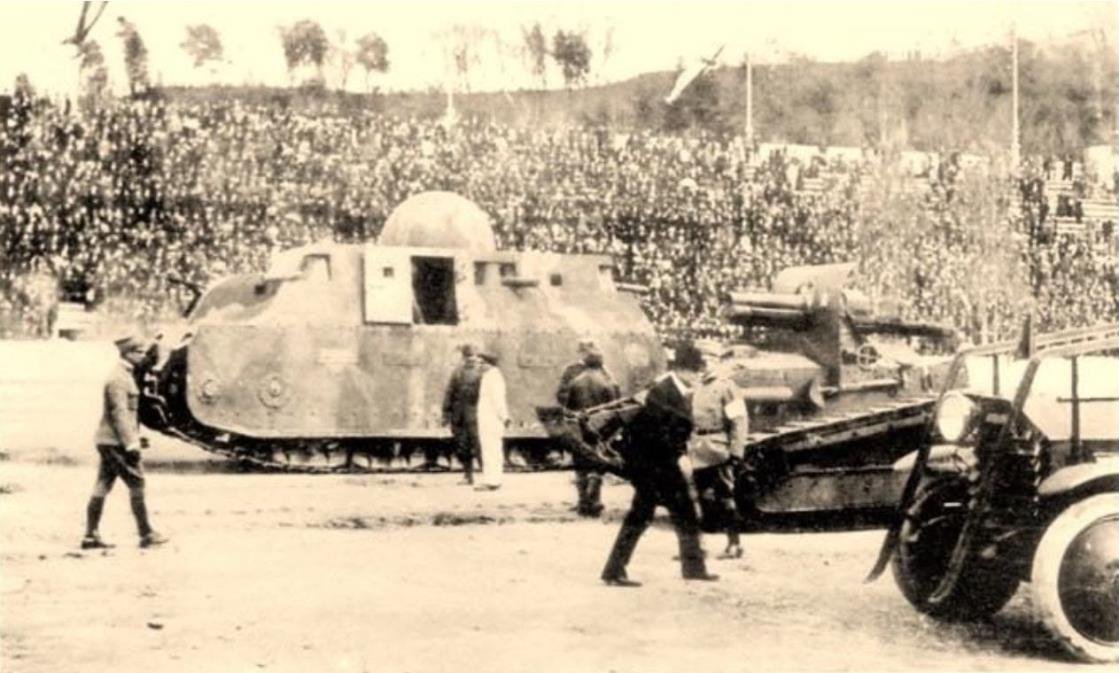
Il Fiat 2000 con il portello aperto davanti alla folla nell’anfiteatro
Fiat 2000 con portello aperto davanti alla folla nell’anfiteatro. Archivio Famiglia Bennicelli.

A seguito della manifestazione fu promosso tenente colonnello e decorato con la medaglia d’argento della Croce Rossa Italiana. La sera del 7 maggio 1919 gli ufficiali dei carri d’assalto festeggiarono il comandante neopromosso. Il tenente Faustini pronunciò il discorso di omaggio a chi per primo aveva compreso l’importanza dell’arma, e chiuse con un brindisi e con la frase «Evviva i Tankisti Italiani!».

Nel corso del 1919 partecipò a esperienze e valutazioni del Fiat 2000 e di un’autoblindo non meglio specificata, destinata alla riconquista della Libia.

Ad agosto fu di nuovo distaccato presso la Fiat, a proseguire il lavoro interrotto nel 1917. La Grande Guerra, anche vinta, lasciò l’Italia in condizioni economiche e sociali precarie.

La crisi limitò lo sviluppo dei tank; l’avversione di parte degli alti gradi e della politica si rafforzò. Bennicelli restò solo e inascoltato. Fu congedato nel 1920 e tornò alla vita civile, continuando però come consulente Fiat nel campo dei carri.

8. Il muro del dopoguerra: perché non fu ascoltato

Finita la guerra, l’interesse per i mezzi corazzati andava via via scemando. Lo spettacolo del 5 aprile non bastò a trasformare l’intuizione in programma. Le fonti sulla nascita dei carristi — in particolare Parri e la sintesi sulla specialità — permettono di isolare tre ragioni strutturali, non riducibili a un singolo nemico personale.

La gelosia di bilancio dei corpi tradizionali

Un’arma nuova sottrae stanziamenti a fanteria, artiglieria e, soprattutto, a una cavalleria gelosa del proprio primato di manovra. Introdurre il carro significava ammettere che il cavallo e il fante appiedato non erano più il centro della guerra. Nessun corpo era disposto a pagare per un’incognita ancora tutta da valutare.

Il dogma della guerra alpina

Lo Stato Maggiore restava ancorato all’idea che la difesa d’Italia si giocasse sulle vette. Un cingolato da 40 tonnellate sembrava un assurdo sulle rocce. Si sottovalutava ciò che Bennicelli aveva visto in Fiandra e tentato di mostrare a Piacenza e a Roma: i carri leggeri potevano operare in valli, pianure e teatri coloniali, e la guerra futura non sarebbe stata solo una replica del Carso. La relazione dell’aprile 1918 lo diceva già: il pesante come base, la squadriglia leggera come strumento.

L’assenza di cultura tecnica e di dottrina

Mancavano specialisti, officine campali, scuole, regolamenti. I comandi, scrive la tradizione carrista, mancavano di una precisa idea di come impiegare i carri in combattimento. In Francia e in Gran Bretagna si cominciava a ragionare di masse corazzate autonome; in Italia il mezzo fu via via relegato a supporto della fanteria.

Va detto con onestà storiografica: non tutte le riserve dei vertici erano pretestuose.

Il Fiat 2000 era troppo lento per molti teatri; l’Italia aveva un problema orografico reale; il bilancio del dopoguerra era asfittico.

La miopia non sta nell’aver rifiutato il 2000 come carro di serie.

Sta nell’aver tratto da quel rifiuto la conclusione sbagliata: che il carro in quanto tale fosse un lusso, un accessorio, una curiosità da parata.

Bennicelli chiedeva altro. Chiedeva produzione di massa del tipo leggero, studio di un mezzo di rottura nazionale, scuole, cooperazione interarmi, autonomia industriale rispetto alla Francia. Ottenne frammenti. Non una dottrina.

Negli anni Trenta la scelta si sarebbe concretizzata nella predilezione per i carri ultraleggeri della serie L, i «carri veloci» da tre tonnellate, a scapito di una linea credibile di medi e pesanti. Non è un capriccio di Bennicelli inascoltato in isolato: è l’esito di un ritardo culturale e industriale che lui aveva denunciato per primo.

9. L’ultima creatura: il Fiat 3000, poi l’agricoltura

Nel 1923 il comandante della Milizia volontaria per la sicurezza nazionale, Italo Balbo, cercò di coinvolgerlo — sfruttandone conoscenze e relazioni — per creare una dotazione di tank per la nuova arma, nata per volere di Mussolini il 1º febbraio di quell’anno. Il tentativo non ebbe successo.

Sempre nel 1923, benché in congedo, fu chiamato dal direttore superiore delle costruzioni di artiglieria, generale A. Torretta, il 23 aprile, a far parte della commissione incaricata delle esperienze sul prototipo del Fiat 3000.

Ebbe la soddisfazione di veder nascere la sua creatura, evoluzione dei Renault, che raggruppava molte delle idee propugnate anni prima. Collaborò anche allo sviluppo del carro a ruote Ansaldo mod. 28, che non andò oltre il prototipo.

Dal 1924 non si occupò più di tank e tornò alle tenute umbre. Nello stesso anno aderì al Partito nazionale fascista.

Nel 1933 assunse incarichi presso l’Università di Agraria di Perugia; la scheda del Senato precisa la carica di presidente della Cattedra ambulante di agricoltura di Perugia.

Il 26 ottobre 1933 il prefetto di Perugia lo propose senatore, nella categoria dei grandi contribuenti. Vittorio Emanuele III lo nominò il 23 gennaio 1934; convalida il 2 maggio, giuramento il 3 maggio.

Con la famiglia reale aveva rapporti di consuetudine familiare. In Senato sedette nella Commissione Agricoltura, dal 17 aprile 1939 al 14 aprile 1941, e poi nella Commissione dell’economia corporativa e dell’autarchia, fino al 5 agosto 1943. Fu anche segretario del Senato dal 15 aprile 1939.

Il 1º ottobre 1927 era intanto nato il Reggimento carri armati, con sede al forte Tiburtino, primo contenitore organico della specialità. Era un riconoscimento tardivo, e ancora su scala ridotta. Bennicelli non ne fu il comandante: ne era stato, anni prima, la ragione tecnica.

Nominato colonnello della riserva, nel 1935 partecipò alle grandi manovre in Alto Adige presso la Divisione motorizzata Trento. Al termine scrisse una relazione critica e severa sull’insufficiente motorizzazione delle forze armate. Le osservazioni furono drammaticamente confermate nella Seconda guerra mondiale.

10. La fattura arrivò in Africa

La Seconda guerra mondiale non punì Bennicelli. Punì i carristi, che si batterono con innegabile eroismo. Quando l’Italia entrò in guerra, il 10 giugno 1940, la massa dei mezzi era ancora fatta di leggeri obsoleti, con pochi medi appena nati e inferiori, per cannone e corazza, ai Cruiser e ai Matilda britannici.

I Fiat 3000, concepiti sull’onda delle dimostrazioni del 1918, combattevano ancora nel 1943. In Sicilia alcuni furono interrati e usati come bunker. È l’immagine più crudele del ritardo: il frutto tardivo della lungimiranza del 1917 impiegato come caposaldo immobile contro uno sbarco anfibio.

La tragicità del divario di mezzi militari ed al contempo l’eroismo dei primi carristi italiani è ben sintetizzato da quello che non a caso sarà l’ultimo messaggio, durante la seconda battaglia di El Alamein, della 132ª Divisione corazzata Ariete, citato nelle memorie di Erwin Rommel: «Carri armati nemici fatta irruzione a sud Divisione Ariete. Con ciò Ariete accerchiata. Trovasi circa 5 chilometri nord-ovest Bir el Abd. Carri Ariete combattono!».

Le cronache della specialità e la memorialistica sul Nordafrica insistono su un punto che non è retorica: il valore individuale dei carristi italiani fu spesso superiore ai mezzi che avevano sotto i cingoli.

Il motto «Ferrea mole, ferreo cuore» — poi titolo anche di studi anglosassoni sull’arma corazzata italiana — sta esattamente in questo scarto: l’acciaio mancò, il cuore no.

Attribuire tutto quello scarto a un singolo ostracismo verso Alfredo Bennicelli non sarebbe corretto.

Attribuirgli il merito di aver visto il problema vent’anni prima, e alle istituzioni il peso di non averlo affrontato, è coerente ai fatti.

Nel 1940, richiamato nella riserva come generale di brigata, ottenne un incarico non operativo a Roma. Fu anche assegnato al comitato di redazione della storia dell’automobilismo militare, sezione carri armati: il comitato non si riunì mai. Come senatore lavorò nelle commissioni di agricoltura e di economia di guerra.

11. L’uomo dietro il generale

Durante la guerra cominciò ad allontanarsi dal fascismo per i contrasti con il segretario del partito, Achille Starace.

Per dimostrare il disaccordo non accettò, tra l’altro, il divieto di esibire nelle cerimonie ufficiali le decorazioni di paesi stranieri: francesi, britanniche, belghe.

Dopo la caduta del fascismo, al contempo, fu emarginato dal governo Badoglio per il passato fascista.

Dopo l’armistizio dell’8 settembre 1943 si ritirò nelle residenze di campagna vicino a Perugia, ed a Solfagnano fu arrestato dai tedeschi in quanto monarchico e per non aver aderito alla Repubblica sociale.

Restò ostaggio e fu incarcerato per diversi mesi nel braccio dei detenuti politici di Regina Coeli.

Di lì, per intercessione di Pio XII, di cui era amico sin dall’infanzia, e del Maresciallo Graziani, con il quale il nipote Francesco Bennicelli era in rapporti molto cordiali, fu liberato, sfuggendo a persecuzioni peggiori.

Nel 1944 fu comunque deferito all’Alta corte di giustizia per le sanzioni contro il fascismo, nel gruppo di imputazione dei senatori ritenuti responsabili di aver mantenuto il fascismo e resa possibile la guerra.

L’istanza di decadenza fu rigettata il 21 ottobre 1944: assolto, nella formula della memoria, da tutte le accuse.

Terminata la guerra e caduta la monarchia, nel 1950 Pio XII lo nominò segretario per le Ambasciate in Vaticano, terza carica civile per importanza nell’allora Corte pontificia.

Sino alla morte, avvenuta a Roma il 30 maggio 1960, si dedicò a quell’incarico e alle terre umbre.
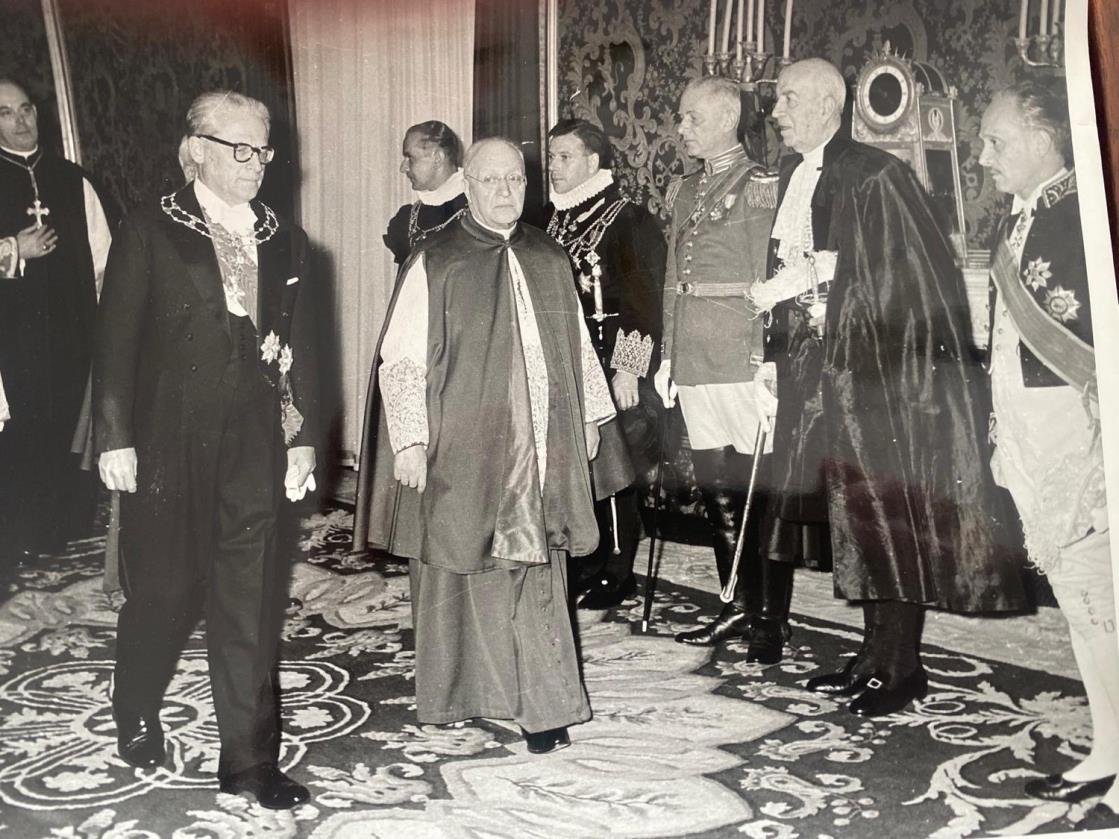
Dignitari della Corte pontificia; Alfredo Bennicelli a destra in cappa nera, gorgiera bianca e spada
Corte pontificia, anni del segretariato. Bennicelli è a destra, di tre quarti: cappa nera, gorgiera bianca, spada. Archivio Famiglia Bennicelli.

L’ufficio toccava le missioni straniere. Il 13 aprile 1951 la principessa Elisabetta e il duca di Edimburgo furono ricevuti in udienza privata da Pio XII; il giorno dopo il seguito e la Corte posarono con le Guardie svizzere.
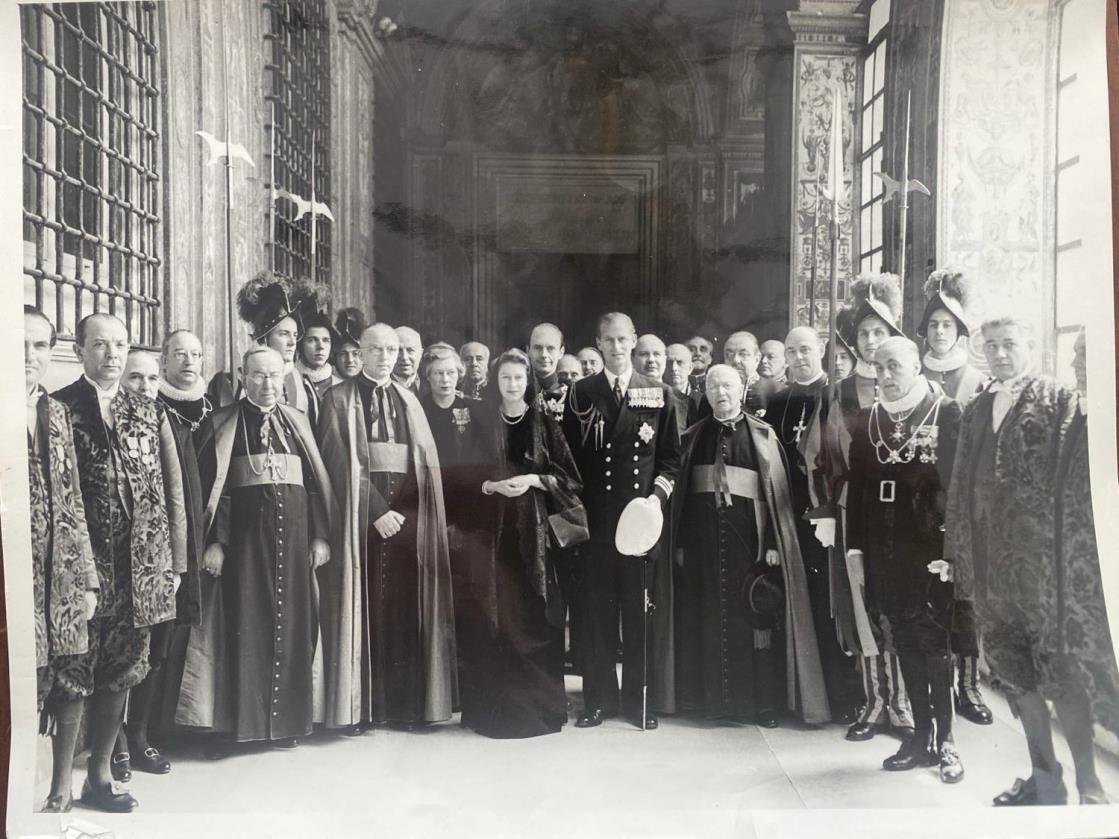
Foto di gruppo in Vaticano, 14 aprile 1951, con la principessa Elisabetta e il duca di Edimburgo al centro
Città del Vaticano, 14 aprile 1951, dopo l’udienza di Pio XII. Al centro la principessa Elisabetta e il duca di Edimburgo. Bennicelli è in seconda fila a destra della principessa Elisabetta. Archivio Famiglia Bennicelli

In piazza San Pietro lo si riconosce subito, perché è il solo dignitario in cappa e spada che guarda in macchina, al centro del corteo, davanti alla sedia gestatoria. Stessa cappa, stesso merletto bianco, stessa fronte alta delle altre due lastre. Intorno, Guardie svizzere, Guardia nobile e la folla; il papa benedice dal trono.
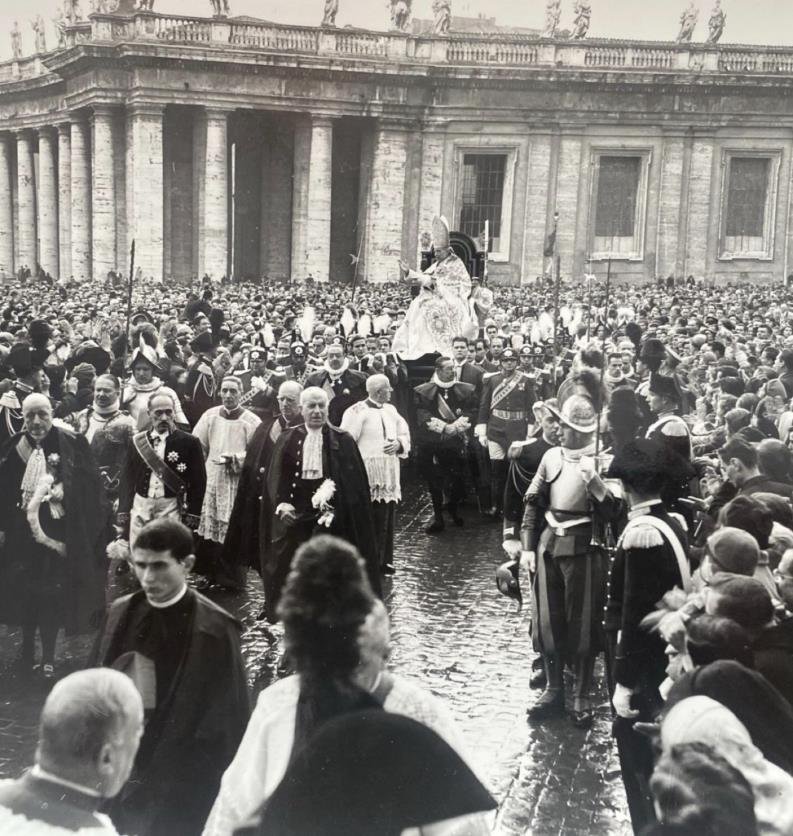
Piazza San Pietro gremita, il papa sulla sedia gestatoria e Bennicelli al centro del corteo
Piazza San Pietro, benedizione dalla sedia gestatoria. Bennicelli è al centro del corteo, in primo piano, cappa nera e merletto bianco, rivolto verso l’obiettivo. Archivio Famiglia Bennicelli

Onorificenze, come risultano dalla memoria

Onorificenza Anno o nota
Croce di guerra al valor militare Italia
Medaglia d’argento della Croce Rossa Italiana 1919, dopo lo Stadio Nazionale
Cavaliere dell’Ordine della Corona d’Italia 1917
Ufficiale della Corona d’Italia 1922
Commendatore della Corona d’Italia 1925
Grande ufficiale della Corona d’Italia 1931
Gran Cordone della Corona d’Italia data non indicata nella memoria
Cavaliere dei Santi Maurizio e Lazzaro 1918
Ufficiale dei Santi Maurizio e Lazzaro 1939
Commendatore dei Santi Maurizio e Lazzaro 1940
Cavaliere della Legion d’onore e Croix de guerre con palme Francia, settembre 1918
Citazione all’ordine dell’armata, firmata da Pétain Francia
Croix de guerre Belgio
Distinguished Service Cross Gran Bretagna
Due promozioni per meriti eccezionali A maggiore e a tenente colonnello

12. Cosa resta

Oggi il ricordo di Bennicelli e della sua lungimiranza vive soprattutto nella memoria dell’Associazione Nazionale Carristi d’Italia e degli appassionati di storia militare.

Va menzionato, in tal senso, il lavoro di chi, a partire dal 2017, ha ricostruito, con grande capacità, una replica funzionante del Fiat 2000 da fotografie d’epoca, pochi disegni e un modello in scala.

Il progetto, apprezzatissimo dalla famiglia Bennicelli nella memoria dell’illustre famigliare, ha riportato materialmente in vita un mezzo di cui non restava lo scafo.

Non restituisce, da solo, la lezione politica e militare della vicenda, ma ne rappresenta la pionieristica intuizione.

La costruzione materiale, avviata a fine novembre 2018, ha usato un motore a benzina, un cannone da 65 mm inerte donato dal Museo della Guerra di Rovereto, e il lavoro di modellazione di Mario Italiani.

Una degna replica dell’originale.
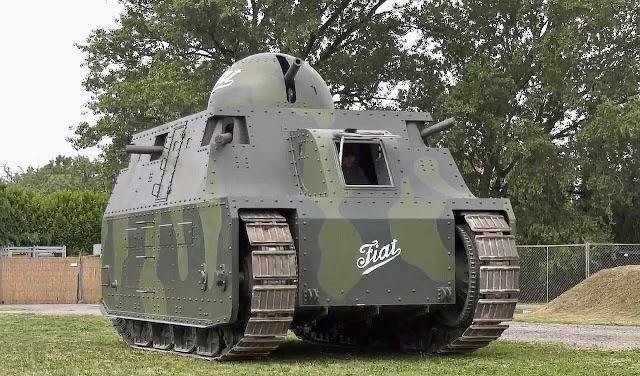
Replica funzionante del carro Fiat 2000 all’aperto, su un prato
Replica funzionante del Fiat 2000, riferimento moderno a colori. Non proviene dall’archivio storico della famiglia

Alfredo Bennicelli vide nel fango delle Fiandre ciò che gran parte dello Stato Maggiore italiano avrebbe accettato solo dopo averlo pagato in vite umane: che la guerra moderna sarebbe stata motorizzata, che i corazzati non potevano restare un accessorio della fanteria, e che un paese senza una propria industria del carro sarebbe rimasto arretrato sul campo di battaglia.

Ottenne uno Schneider, quattro Renault, due giganti Fiat mai prodotti in serie, un ordine di 1.400 carri tagliato il giorno dopo la vittoria, un semovente da 105, una commissione, alcune parate, la nascita ideale del Fiat 3000, un reggimento nel 1927.

Non ottenne una dottrina. La sua sconfitta non fu personale. Fu il sintomo di un esercito che, uscita la Grande Guerra, preferì interpretare la vittoria come conferma dell’ordine esistente invece che come obbligo di cambiare arma.

Quando i carristi italiani, anni dopo, andarono in linea ripetendo «Ferrea mole, ferreo cuore», onoravano anche — senza saperlo sempre — il capitano che per primo aveva chiesto la mole, e a cui era stato lasciato soprattutto il cuore.

13. Fonti e percorsi di verifica

Le affermazioni riposano sulla memoria familiare, sul saggio illustrato e sulle carte e sugli studi qui sotto.

Resta aperto un lavoro d’archivio sulle relazioni originali di Bennicelli a Dallolio e sugli atti della Commissione armi e munizioni del 1918-23.

Il materiale fotografico famigliare non è riproducibile salvo previa autorizzazione.

Archivio e scritti di Alfredo Bennicelli

  • Archivio Famiglia Bennicelli. Fotografie delle prove del Fiat 2000; telegramma di Winston Churchill del 1918; fotografie di Corte pontificia con il conte in abito di cameriere segreto di cappa e spada.
  • Alfredo Bennicelli, Artiglierie su carri blindati a cingolo, 1918. Studio tecnico citato nel testo: trasformazione degli FT in semoventi da 75 e 105 mm.
  • Alfredo Bennicelli, I primi tanks o carri armati, in Realtà, 1936.
  • Alfredo Bennicelli, Cenni sui primi tanks o carri armati, Officine tipo-litografiche I.G.A.P., 1936.
  • Alfredo Bennicelli, A Regina Coeli. Con i politici del terzo braccio, in proprio, 1945.

Sul conte e sulle origini della specialità

  • Nicola Pignato, Nel centenario della nascita. Il conte Bennicelli, pioniere italiano dei carri armati.
  • Nicola Pignato, Le origini del carrismo in Italia, Rivista Militare, anno C, n. 5, settembre-ottobre 1977, pp. 89-93.
  • Pierfranco Malfettani, Alfredo Bennicelli, «padre nobile» dell’arma corazzata italiana, Storia Militare, n. 319, 2020.
  • Filippo Cappellano e Pierfranco Malfettani, Carri armati per la Milizia?, Storia Militare, n. 359, 2023.
  • Rodolfo Ballardini, Alfredo Bennicelli, il padre del carrismo italiano, Rivista Italiana Difesa, n. 3, marzo 2009, pp. 85-97.
  • Filippo Cappellano e Nicola Pignato, Il carro armato e l’Esercito italiano nella Grande Guerra, Storia & Battaglie, n. 79, aprile 2008.
  • Maurizio Parri, Storia dei carristi e del 32º Reggimento carri, edizione in proprio.
  • Senato della Repubblica, scheda di Alfredo Bennicelli, https://notes9.senato.it/web/senregno.nsf/
  • Andrea Cionci, La Stampa, 12 settembre 2017, e i servizi 2020-2022 sulla replica del Fiat 2000; testimonianza di Filippo Bennicelli.
  • Associazione Nazionale Carristi d’Italia, memoria della specialità, motto, sostegno alle repliche.

Mezzi, industria, impiego

  • Bruno Benvenuti, Il carro armato Fiat 2000 e le prime tanks italiane, Storia Militare, n. 12, 1994.
  • Storia Militare, Carri armati nella Grande Guerra, n. 285, 2017.
  • Stato Maggiore dell’Esercito, Ufficio storico, Gli autoveicoli da combattimento dell’Esercito italiano, vol. 1, Dalle origini fino al 1939, 2002.
  • Lucio Ceva e Andrea Curami, La meccanizzazione dell’Esercito fino al 1943, Stato Maggiore dell’Esercito, Ufficio storico.
  • Alessandro Gionfrida, L’Italia e il coordinamento militare interalleato nella Prima guerra mondiale, Stato Maggiore dell’Esercito, Ufficio storico.
  • AA. VV., Fronte terra. Carri armati in servizio fra le due guerre, vol. 1, Edizioni Bizzarri, 1973.
  • Ugo Barlozzetti e Alfredo Pirella, Mezzi dell’Esercito italiano 1935-1945, Editoriale Olimpia, 1986.
  • Bruno Benvenuti, Cesare Falessi e Bruno Pafi, Storia dei mezzi corazzati, Fratelli Fabbri Editori, 1976.
  • Bruno Pafi, Cesare Falessi e Giuseppe Fiore, Corazzati italiani 1939-45, D’Anna, Roma.
  • P. E. Papò, Mezzi corazzati italiani. I primi quarant’anni, IBN Editore.
  • Nico Sgarlato, I carri armati leggeri italiani dal 1919 al 1970, IBN Editore.
  • Nicola Pignato, Motori!!! Le truppe corazzate italiane 1919-1943, GMT.
  • Nicola Pignato, I mezzi blindo-corazzati italiani 1923-1943, Storia Militare.
  • Vincenzo Meleca, I carri armati poco conosciuti del Regio Esercito, Tracce per la Meta Edizioni.
  • Antonio Tallillo, Andrea Tallillo e Daniele Guglielmi, Carro Fiat 3000. Sviluppo, tecnica, impiego, Gruppo modellistico trentino di studio e ricerca storica.
  • J. J. Timothy Sweet, Iron Arm. The Mechanization of Mussolini’s Army, 1920-40, Stackpole Military History Series.
  • Tank Encyclopedia, schede Fiat 2000, Fiat 3000 e Renault FT in Italian Service.
  • Mario Picone Chiodo, In nome della resa. L’Italia nella Seconda guerra mondiale (1940-1945), Mursia, 1987.

Le tavole di contesto — ufficio, Fiandre, Schneider, schema 1917-1927 — sono state create per corredare il saggio e non hanno pretesa di accuratezza.

Alfredo Bennicelli and the unfinished birth of the Italian tank arm

The Fiat 2000 tank at a public demonstration, with its hatch open
Fiat 2000 at a public demonstration, hatch open in front of the crowd. Bennicelli Family Archive.

1. A pioneer

In the military history of twentieth-century Italy there are men who change the way an army ought to think about battle. Count Alfredo Bennicelli belongs to this second group. A reserve artillery officer, a mechanic by vocation, a farmer of large estates, an observer on the Western Front, later lieutenant colonel, colonel of the reserve, brigadier general, Senator of the Kingdom and Papal Secretary of Embassies, he is remembered by the historians of the speciality as the first Italian officer to be formally and systematically tasked with studying the tank and, ideally, as the founder of the Italian tank troops, the carristi.

His story is not just a biography. It is the story of a foresight that, between 1917 and the early 1920s, clashed with financial caution, the jealousy of the traditional corps and a strategic culture still nailed to the Alps and to the infantry. That clash, documented in the chronicles of the tank veterans’ association and in accounts of the birth of the speciality, would weigh for a long time on the motorisation of the army.

The historian Mario Picone Chiodo, in “In nome della resa” [In the Name of Surrender] (Milan, Mursia, 1987), put it bluntly: the only person in Italy who understood the importance of the tank was Count Alfredo Bennicelli, head of the assault-tank office at the Commissariat for Arms and Munitions. He would have liked to pursue his studies after the war, but was dissuaded by a government that feared such conspicuous machines as a provocation to the social order, and was «neutralizzato del tutto» [“completely neutralised”] by his appointment as senator in 1934.

2. A technical vocation before a military one

Alfredo Bennicelli was born in Rome on 19 February 1879, the first-born son of Count Achille and Elisabetta Martinori. The Senate record lists his siblings Filippo, Riccardo and Maria Antonietta.

He belonged to a wealthy Roman family with close ties to the Papal Court, which it served without interruption under seven popes, from Pius IX to Paul VI.

He grew up in Rome, studied at a boarding school in Florence and went on to the University of Agriculture.

He learned French and English, languages that would serve him on his missions to the Allies. From a young age he was passionate about mechanics and the mechanisation of agriculture.

At eighteen he obtained a licence to drive automobiles: the family was among the first in Italy to own one. At twenty-six he came into possession of his first car, a 1905 Benz, which — like all those that followed, and like clocks and other mechanisms — he repaired and tuned himself.

At the beginning of the twentieth century he did his military service as a reserve second lieutenant in the 13th Field Artillery Regiment in Rome. It was a family tradition: many of the Bennicellis passed through one branch or another of the artillery. He was not a career officer in the strict sense.

Once discharged, he devoted himself to running his farming estates in Lazio and Umbria, more than five thousand hectares, improving their management and starting their mechanisation.

He married Rosanna dei marchesi Spinola, of the family of the Marquesses Spinola. Their son Alberto was born of the marriage.

His great-nephew Filippo, interviewed by La Stampa in 2017, would remember him as «un gigante che ci aiutava a riparare i nostri giocattoli» [“a giant who helped us repair our toys”], an authoritative figure who was at the same time «dotata di una particolare dolcezza» [“gifted with a particular gentleness”] with children. The image is no mere footnote: it speaks of a man able to hold workshop and family together.

Personal and institutional profile

Item Detail
Birth / death Rome, 19 February 1879 – Rome, 30 May 1960
Parents Achille Bennicelli and Elisabetta Martinori
Siblings Filippo; Maria Antonietta; Riccardo, killed at Tolmino in 1917
Spouse and son Rosanna dei marchesi Spinola; Alberto Bennicelli Bonini
Senatorial residence Via di Villa Albani 14-16, Rome
Rank From reserve second lieutenant to brigadier general of the reserve (1940)
Civil offices Industrialist and farmer; president of the Cattedra ambulante di agricoltura (itinerant agricultural advisory service) of Perugia; senator from 23 January 1934; from 1950 Papal Secretary of Embassies
Estates More than 5,000 hectares in Lazio and Umbria

3. Requisitions, Fiat and the prelude to the tank

When Italy entered the war on 24 May 1915, he was recalled and assigned to the office requisitioning motor vehicles for military use. At first he had authority over the provinces of Rome, Terni and Perugia; then over Piedmont, Lombardy and Veneto as well. He stood out for his mechanical competence and was posted to Fiat in Turin, where he organised the repair and conversion of damaged vehicles and supervised the construction of cars and lorries built to military specifications.

In particular, he followed the development of the vehicles for towing heavy artillery: Fiat 20B, Fiat 30, Pavesi-Tolotti A and B, with special attention to their use on mountain roads, typical of the Italian front. The work did not stop at procurement.

He trained «autieri esperti» [“expert drivers”] and gathered from the units and depots the modifications to be introduced into production. His visits to the front were intense and continuous. This commitment earned him promotion to captain.

That spell in Turin is the true prelude to the Italian tank arm. Bennicelli learned to think in terms of engines, logistics, wear and industry, not only of textbook tactics. When the Ministry of War decided to investigate the new weapon that had appeared on the Western Front, it already had the right man.

The Fiat 2000 tank during a public demonstration, with spectators in the background
Another photograph of the Fiat 2000 at a public demonstration. Bennicelli Family Archive.

4. In Flanders: seeing the future in the mud

Italian interest in tanks came late and cautiously. The first British Mark I tanks appeared on the Somme on 15 September 1916.

The Royal Italian Army, according to the account established in the encyclopaedia entry on the carrista and in Maurizio Parri’s chronicle, approached the vehicle «con molta cautela» [“with great caution”]: enormous costs, specific training, the absence of logistics and maintenance specialists, the lack of a doctrine of employment and «una diffusa diffidenza circa le loro reali possibilità d’affermarsi sul campo di battaglia» [“a widespread mistrust of their real chances of proving themselves on the battlefield”].

With the appearance in France and Britain of the first armoured machines, on 2 January 1917 the Ministry of War issued Alfredo Bennicelli a diplomatic passport for France, where the first tank units were being formed. The assignment came directly from the minister, Lieutenant General Vittorio Italico Zupelli. Bennicelli wrote in his reports that the adoption of those «formidabili macchine» [“formidable machines”] could help to break the deadlock of the Western Front.

Through General Alfredo Dallolio, head of the Franco-Italian commission, he visited the Schneider works, the Grand Quartier Général at Bragance and the training centre at Marly.

He met the French generals Estienne and Dupont to negotiate the transfer of a Schneider tank to the Royal Army. Amid hitches and obstacles, and thanks to the personal commitment of the ambassador in Paris, the Marquis Salvago Raggi, he managed to examine the French and British tanks deployed on the Ypres front.

The family memoir records an episode that the open-access summaries phrase differently: on 17 August 1917, the first and, as far as is known, the only Italian to do so, he took part in a live-fire attack at Poperinge, personally driving a Renault FT.

On that occasion Bennicelli tested the French tanks in combat several times and became convinced that the tank best suited to the Royal Army would be the Schneider.

The encyclopaedia entry moves the British attack to 9 August 1917 and places his admiration for the Schneider in a later French action on the Somme.

The two versions must be kept distinct: the chronology of the memoir is consistent with the passport of January 1917 and with an action in Flanders in the summer; the attribution to the Somme, also repeated by La Stampa in 2017, is incompatible with the debut of tanks on that river, which took place in September 1916, before his mission.

He also studied a captured German A7V and was not impressed by it.

Illustrated reconstruction of a Renault FT tank in a demonstration run in front of ancient walls
Hypothetical reconstruction of a Renault FT in a demonstration run.

From the mission he obtained a concrete and rare result: a Schneider, serial number 212, transferred to Italy for evaluation. The trials at Tricesimo were positive: the tracks worked on Italian terrain too, at least in principle. Italy then asked for more vehicles. The report he submitted led Dallolio to order 100 Renault FTs and 20 Schneider CA1s from France.

Illustrated reconstruction of a Renault FT tank in action on desert terrain, with lorries and palm trees
Hypothetical reconstruction of the Renault FT in action.

The diplomacy of machines

On 10 October 1917 he was issued a new diplomatic passport. With the engineer Lieutenant Pasqualini he returned to France to negotiate the supply or, failing that, production under licence. They visited armament factories and the Renault and Peugeot proving grounds, noting strengths and weaknesses. During this mission Bennicelli was promoted to major and strengthened his connections in the French and British armies, among industrialists, technicians, politicians and statesmen.

The military situation of the Allies was far from brilliant: the Germans and Austro-Hungarians were advancing, and France and Britain refused supplies to Italy in order to reserve them for their own armies. Through stubborn mediation, and despite French resistance, he nevertheless obtained four Renault FTs, to be evaluated in Italy with a view to national production.

La Stampa, in 2017, summed up the outcome curtly: against a request on the order of more than a hundred tanks — the memoir speaks of a hundred FTs and twenty Schneiders — the «cugini d’oltralpe» [“cousins beyond the Alps”] were «avarissimi» [“extremely stingy”].

In the meantime, news reached Bennicelli that his brother Riccardo, an artillery captain decorated with three silver medals for military valour, had been killed by a sniper on the Tolmino front during a reconnaissance, two days before the great Austro-Hungarian offensive at Caporetto.

For Alfredo the loss was a terrible grief. Years later, at his own expense, he had an elementary school named after his brother built on the Solfagnano estate in Umbria. In a photograph of the Fiat 2000 trials, shown below, he appears with a mourning band on his arm.

The point must be held firm. Bennicelli did not invent the Italian tank in a laboratory: he saw it in war, measured its limits, understood that Italy could not depend on its allies and pushed national industry to produce its own. At the end of 1918, according to Parri, there were seven tanks in all on Italian soil: two Fiat 2000s, one Schneider and four Renault FTs. That was the minimum stock from which a modern army should have started. It did not start.

Churchill, the Légion d’honneur, the Mark IVs

On 28 July 1918 a telegram from Minister Zupelli to General Nicolis di Robilant, head of the Italian delegation at Versailles, reported that Italy was prepared to produce the FT for its French ally as well. In exchange, at the direct request of General Armando Diaz to Generalissimo Foch, it asked for the immediate supply of «almeno» [“at least”] twenty-five tanks for the imminent surprise offensives on the Italian front, and some modified medium Schneiders.

The mission continued with high-level meetings. On 15 August, at the Ritz hotel in Paris, Bennicelli saw Winston Churchill, then British Minister of Munitions, who had taken over that ministry in July 1917 after supporting the Landships Committee from which the first tanks had sprung.

The archive telegram, reproduced here, is an invitation to dinner at 8 p.m.

Typewritten note from Winston Churchill inviting Major Bennicelli to dinner at the Ritz Hotel, 15 August 1918
Winston Churchill’s invitation to Major Bennicelli for dinner at the Ritz Hotel, 15 August 1918. Bennicelli Family Archive.

In September the French Ministry of Armament ordered the major’s appointment as a Chevalier of the Légion d’honneur and the award of the Croix de guerre with palms, for the courage he had shown at the front driving tanks and for his commitment to championing the use of tanks in Italy.

In October Churchill personally considered the possibility of supplying Italy with fifty Mark IVs and of sending Italian personnel to France for training as soon as possible.

To these Allied honours the memoir adds the Belgian Croix de guerre, the British Distinguished Service Cross and a citation in the orders of the French army signed by Pétain.

5. Two ideas of the tank, one industry

Diagram of the evolution of the Italian armoured vehicle 1917-1927: Flanders mission, Schneider CA1, Fiat 2000, Fiat 3000, Tank Regiment
Summary diagram 1917-1927, plate accompanying the essay.

5.1 The Fiat 2000: mobile fortress and dead end

Italy had begun its studies in 1916, when the French and British projects were still unknown in the country. Between 1916 and 1918 Fiat, building on an impetus already set in motion by a 1915 contract and with design contributions from Giulio Cesare Cappa and Carlo Cavalli, produced the first entirely Italian heavy tank.

The prototype was presented to the authorities on 21 June 1917: the mechanics were final, while armour and armament came later, together with the trials near Turin. Only two were ever built, one in 1917 and one in 1918.

In April 1918 Major Bennicelli was sent to Treviso, to the Campo Esperienze Z testing ground, to attend the first acceptance trials and to write a technical report based on what he had seen in France.

He wrote that the great tank had been conceived to «costruire una macchina blindata con trasmissione a cingoli, potentemente armata e blindata, che potesse con facilità manovrare sui terreni pietrosi del Carso, quale base di numerosa squadriglia di altre macchine, più leggere e rapide» [“build an armoured machine with tracked transmission, powerfully armed and armoured, able to manoeuvre easily over the stony ground of the Carso, as the base of a large squadron of other machines, lighter and faster”]. He praised the mechanical structure, the armament and the armour plating made by Ansaldo of Genoa-Sampierdarena, and its ability to cross rivers, knock down obstacles and cross trenches.

On the other hand, he pointed out the open problems: machine guns that needed ball mounts; a single exit hatch for the crew; the impossibility of firing the gun at a steep angle of depression, which made it useless at close quarters; dimensions that ruled out rail transport unless the tank was dismantled into two parts; armour, on-board weapons and lines of fire not yet tested, as Fiat itself admitted.

He suggested reduced propellant charges for the 65 mm gun. In the discussions on armament he also pressed for a 75/76 mm piece in the turret; the 65/17 mountain gun prevailed.

For its time it was not a crude vehicle. It was a colossus of about 40 tonnes — the technical data sheets give 38.78 t, 7.40 m long, 3.20 wide, 3.80 high — with 15-20 mm armour, a six-cylinder Fiat A12 aero engine of about 250 hp (some association chronicles mistakenly say 600), a speed of around 6-7.5 km/h, a crew of 8-10 men, a 65/17 gun or howitzer in a revolving turret and a ring of Fiat-Revelli machine guns.

The Tank Encyclopedia describes it as a well-conceived heavy tank, with an engine compartment separate from the fighting compartment and a top-mounted turret that anticipated solutions destined to become standard.

Illustrated reconstruction of a devastated Flanders landscape during the First World War
Hypothetical Flanders landscape during the First World War.
Alfredo Bennicelli beside the Fiat 2000 during a demonstration
Alfredo Bennicelli during a demonstration of the FIAT 2000, with a mourning band on his arm.

Its operational fate confirmed the doubts about its mobility.

At Bennicelli’s suggestion, the only superior who backed him — General Zupelli — took the matter up with the Minister of the Colonies. Approval came: two Renault FTs and one of the two Fiat 2000s left for Tripoli. The vehicles arrived in February 1919. The Libyan experiments were interesting.

The tanks moved over sandy and stony ground, but were far too slow: the slowness had already been reported by Bennicelli, who had commissioned studies of tanks capable of twice the speed and with more powerful armament.

The psychological effect against the guerrillas was strong; the ability to pursue fast-moving formations in the desert was not. All trace of the African example was lost. The second remained in Italy for demonstrations; it was modified in 1934 with Vickers-Terni 37/40 light guns in place of two front machine guns, exhibited on 3 September 1934 at Campo Dux in the Parioli district, ended up as a monument at the Corrado Mazzoni barracks in Bologna, home of the 3rd Armoured Infantry Regiment, and is still recorded there in 1936. It was later scrapped. No original Fiat 2000 survives.

5.2 The Renault FT and the light-tank route

Aware that the 2000 was too slow and cumbersome, designers and commands turned to the Renault. To increase the interest of the armed forces, politicians, industry and the press, Bennicelli quickly organised a demonstration. On 2 August, as the Tank Encyclopedia reports, the four Renault FTs that had arrived were, by May, ready for the command.

The substance of the display, on the ramparts of the ancient walls of Piacenza: under Bennicelli’s guidance an FT overcame steep drops and trenches, a ditch 5 metres wide and 2 deep, heaps of sand and large boulders, a car, and climbed over a 4.5-metre embankment.

The display was convincing. The Arms and Munitions Commission issued an order for 1,400 Renault FTs to be produced in Italy. That same evening, armed with his credentials, he left for Paris with orders to negotiate the licence.

On 25 September Fiat and Ansaldo informed him that they had organised the forthcoming production of 400 assault tanks, modified according to his instructions so as to ford watercourses 1.20 metres deep.

In October he prepared a budget estimate for 1,400 tanks, divided into lots among the manufacturers and to be delivered in the first six months of 1919. Along with them: 60 radio tanks («carri d’assalto con telegrafo senza fili» [“assault tanks with wireless telegraph”]), 150 trailers for road transport, 100 seven-tonne lorries, 37 mm light guns, machine guns and the type of ammunition required.

In that same year, 1918, he prepared the technical study Artiglieria e carri blindati cingolati [Artillery and tracked armoured vehicles], which envisaged converting the FTs into self-propelled mounts for 75 and 105 mm guns, simply by removing the turret and a few other parts.

One of these self-propelled guns was built by Ansaldo of Genoa immediately after the end of the war. It would appear at the Stadio Nazionale.

The Fiat 3000 was born nonetheless, the first Italian series-production tank: about 150 built between the Model 21, armed with machine guns, and the Model 30, with a 37/40 gun; it was faster than the FT thanks to a 50 hp Fiat engine and Italian design solutions.

It entered service in 1921-22 and remained in the line, incredibly, until 1943.

It was the backbone of the first battalions. It fought in Libya at Giarabub in 1926, in Ethiopia and, by then obsolete, on the Greek-Albanian front and in Sicily, where some were used as fixed pillboxes.

It was the most that Italy had managed to derive from the impetus of 1917-18. It was not yet an independent armoured force.

Brief comparison

Item Fiat 2000 Fiat 3000
Years and units built 1917-1918, 2 built c. 1921-1930, about 150
Weight about 40 t (38.78 t on the data sheet) about 5.5-6 t
Engine Fiat A12, about 250 hp Fiat 4-cylinder, 50-63 hp
Speed 6-7.5 km/h up to about 21 km/h
Armament 65/17 in turret and 7 machine guns 2 × 6.5 mm MGs (Mod. 21) or 37/40 (Mod. 30)
Intended role Mobile fortress, base for a light squadron Light series-production assault tank
Fate Libya, parades, monument, scrapped Libya, Ethiopia, Greece, Sicily 1943

6. The end of the war and the stocktaking of 27 December

The great Italian and Allied offensive on the Piave, and the capitulation of the Austro-Hungarian armies, ended the war on the Italian front.

Shortly afterwards the German Empire capitulated too. Within a few days, on the orders of the head of the Commissariat for Arms and Munitions, His Excellency Conti, the construction of the 1,400 tanks was suspended.

On 27 December 1918 itself Bennicelli wrote to his superiors to take stock, so as not to waste the experience, the designs and the money already spent by the State and by the companies to start production. He suggested gathering the procured materials, engines, armaments and components in a single military arsenal, so as to complete at least the tanks that could still be built.

His hope was that the authorities would follow the example of the Allies, who, once the war was over, continued to develop their armoured arm.

Many of the senior officers did not believe — wrongly, as the Second World War would show— in the use of tanks on the Italian fronts.

The demobilisation of the army and of the colossal industrial apparatus was considered a priority. Almost no one listened to him.

7. The apotheosis of 1919, and the discharge

Stubbornness did the rest. He organised one last coup de théâtre for the benefit of the Italian Red Cross. On 5 April 1919, at the Stadio Nazionale in Rome, in the presence of the King, the Crown Prince, the entire royal family, the political and military leadership, the press and a huge crowd, onto the field came an FT with a machine gun, the 105 mm self-propelled gun, the 40-tonne Fiat 2000, two Ansaldo armoured cars and an Itala mountain lorry. The Schneider stayed offstage. One of the FTs was driven by Bennicelli, who was slightly injured by a pole that entered the cab through a small hatch left open, while the tank climbed over and demolished an old horse-drawn omnibus.

Tanks and armoured cars performed manoeuvres and climbs, crossing ditches, trenches and barbed wire. At the end, amid the cheers of the crowd, all the vehicles left the stadium through a breach made by the Fiat 2000 in the perimeter wall. In his own words: «Lo spettacolo, che consisteva nel mostrare che cosa fossero i carri d’assalto e che cosa potessero compiere contro qualsiasi ostacolo, riuscì benissimo, perché l’incasso per la Croce Rossa fu molto ingente, il pubblico si divertì assai e perché molti, ancora increduli, dovettero convincersi che quelle potenti macchine avevano in sé possibilità di impiego superiori al previsto» [“The show, which consisted in demonstrating what assault tanks were and what they could achieve against any obstacle, was a great success, because the takings for the Red Cross were very large, the public enjoyed itself greatly, and because many, still incredulous, had to admit that those powerful machines held possibilities of use greater than expected”].

The Fiat 2000 with its hatch open in front of the crowd in the amphitheatre
Fiat 2000 with hatch open in front of the crowd in the amphitheatre. Bennicelli Family Archive.

Following the event he was promoted to lieutenant colonel and awarded the silver medal of the Italian Red Cross. On the evening of 7 May 1919 the officers of the assault tanks celebrated their newly promoted commander. Lieutenant Faustini delivered the speech in homage to the man who had been the first to understand the importance of the arm, and closed with a toast and the words «Evviva i Tankisti Italiani!» [“Long live the Italian Tankmen!”].

During 1919 he took part in trials and evaluations of the Fiat 2000 and of an unspecified armoured car intended for the reconquest of Libya.

In August he was again seconded to Fiat, to continue the work interrupted in 1917. The Great War, though won, left Italy in precarious economic and social conditions.

The crisis held back the development of tanks; the hostility of part of the senior officers and of the political world hardened. Bennicelli was left alone and unheeded. He was discharged in 1920 and returned to civilian life, while continuing to act as a Fiat consultant on tanks.

8. The post-war wall: why he was not heard

Once the war was over, interest in armoured vehicles gradually waned. The show of 5 April was not enough to turn the intuition into a programme. The sources on the birth of the tank troops — in particular Parri and the overview of the speciality — make it possible to isolate three structural reasons, which cannot be reduced to a single personal enemy.

The budget jealousy of the traditional corps

A new arm takes funding away from the infantry, the artillery and, above all, from a cavalry jealous of its primacy in manoeuvre. Introducing the tank meant admitting that the horse and the foot soldier were no longer the centre of warfare. No corps was willing to pay for an unknown quantity that had yet to be assessed.

The dogma of Alpine warfare

The General Staff remained anchored to the idea that the defence of Italy would be decided on the mountain peaks. A 40-tonne tracked vehicle seemed absurd among the rocks. What Bennicelli had seen in Flanders and tried to show at Piacenza and in Rome was underestimated: light tanks could operate in valleys, plains and colonial theatres, and the war of the future would not be merely a replay of the Carso. The April 1918 report had already said so: the heavy tank as the base, the light squadron as the instrument.

The absence of technical culture and doctrine

There were no specialists, no field workshops, no schools, no regulations. The commands, the tank-corps tradition writes, lacked a precise idea of how to employ tanks in combat. In France and Britain people were beginning to think in terms of independent armoured masses; in Italy the vehicle was progressively relegated to infantry support.

In fairness to history it must be said that not all the reservations of the top brass were mere pretexts.

The Fiat 2000 was too slow for many theatres; Italy had a real problem of terrain; the post-war budget was starved.

The short-sightedness does not lie in having rejected the 2000 as a series-production tank.

It lies in having drawn the wrong conclusion from that rejection: that the tank as such was a luxury, an accessory, a parade-ground curiosity.

Bennicelli was asking for something else. He was asking for mass production of the light type, the study of a national breakthrough vehicle, schools, inter-arms cooperation, industrial independence from France. He obtained fragments. Not a doctrine.

In the 1930s the choice would take concrete form in the preference for the ultralight tanks of the L series, the three-tonne «carri veloci» [“fast tanks”], at the expense of a credible line of medium and heavy tanks. This is not the whim of a lone, unheeded Bennicelli: it is the outcome of a cultural and industrial delay that he had been the first to denounce.

9. His last creation: the Fiat 3000, then agriculture

In 1923 the commander of the Voluntary Militia for National Security, Italo Balbo, tried to involve him — drawing on his knowledge and connections — in creating a tank establishment for the new force, founded at Mussolini’s behest on 1 February of that year. The attempt did not succeed.

Also in 1923, although discharged, on 23 April he was called by the director-general of artillery construction, General A. Torretta, to join the commission responsible for the trials of the Fiat 3000 prototype.

He had the satisfaction of seeing his creation born, an evolution of the Renaults that brought together many of the ideas he had advocated years before. He also collaborated on the development of the Ansaldo Mod. 28 wheeled tank, which did not go beyond the prototype stage.

From 1924 he no longer dealt with tanks and returned to his Umbrian estates. In the same year he joined the National Fascist Party.

In 1933 he took up posts at the University of Agriculture in Perugia; the Senate record specifies the office of president of the Cattedra ambulante di agricoltura of Perugia.

On 26 October 1933 the Prefect of Perugia proposed him for the Senate, in the category of the largest taxpayers. Victor Emmanuel III appointed him on 23 January 1934; his appointment was validated on 2 May and he took the oath on 3 May.

He was on close, long-standing family terms with the royal family. In the Senate he sat on the Agriculture Committee, from 17 April 1939 to 14 April 1941, and then on the Committee for the Corporative Economy and Autarky, until 5 August 1943. He was also Secretary of the Senate from 15 April 1939.

Meanwhile, on 1 October 1927, the Tank Regiment had been formed, based at Forte Tiburtino, the first organic home of the speciality. It was a belated recognition, and still on a small scale. Bennicelli was not its commander: years before, he had been its technical raison d’être.

Appointed colonel of the reserve, in 1935 he took part in the great manoeuvres in Alto Adige with the Trento Motorised Division. Afterwards he wrote a critical and severe report on the insufficient motorisation of the armed forces. His observations were dramatically confirmed in the Second World War.

10. The bill came due in Africa

The Second World War did not punish Bennicelli. It punished the tankmen, who fought with undeniable heroism. When Italy entered the war on 10 June 1940, the bulk of its armour still consisted of obsolete light tanks, with a few medium tanks that had only just appeared and were inferior, in gun and armour, to the British Cruisers and Matildas.

The Fiat 3000s, conceived in the wake of the 1918 demonstrations, were still fighting in 1943. In Sicily some were dug in and used as bunkers. It is the cruellest image of the delay: the late fruit of the foresight of 1917 used as an immobile strongpoint against an amphibious landing.

The tragedy of the gap in military equipment, and at the same time the heroism of the first Italian tankmen, are well summed up by what would, not by chance, be the last message of the 132nd Armoured Division Ariete during the Second Battle of El Alamein, quoted in the memoirs of Erwin Rommel: «Carri armati nemici fatta irruzione a sud Divisione Ariete. Con ciò Ariete accerchiata. Trovasi circa 5 chilometri nord-ovest Bir el Abd. Carri Ariete combattono!» [“Enemy tanks broken through south of Ariete Division. Ariete thereby encircled. Position about 5 kilometres north-west of Bir el Abd. Ariete tanks fighting!”].

The chronicles of the speciality and the memoirs on North Africa insist on a point that is not rhetoric: the individual valour of the Italian tankmen was often greater than that of the vehicles under their tracks.

The motto «Ferrea mole, ferreo cuore» [“Iron hull, iron heart”] — later also the title of English-language studies of the Italian armoured arm — lies exactly in this gap: the steel was lacking, the heart was not.

To attribute that whole gap to a single act of ostracism towards Alfredo Bennicelli would not be correct.

To credit him with having seen the problem twenty years earlier, and to lay on the institutions the burden of not having tackled it, is consistent with the facts.

In 1940, recalled to the reserve as a brigadier general, he was given a non-operational post in Rome. He was also assigned to the editorial committee for the history of military motoring, tank section: the committee never met. As a senator he worked on the committees for agriculture and the war economy.

11. The man behind the general

During the war he began to distance himself from Fascism because of clashes with the party secretary, Achille Starace.

To show his disagreement he refused, among other things, to accept the ban on wearing decorations from foreign countries — French, British, Belgian — at official ceremonies.

At the same time, after the fall of Fascism, he was sidelined by the Badoglio government because of his Fascist past.

After the armistice of 8 September 1943 he withdrew to his country residences near Perugia, and at Solfagnano he was arrested by the Germans as a monarchist and for not having joined the Italian Social Republic.

He was held hostage and imprisoned for several months in the political prisoners’ wing of Regina Coeli.

From there, through the intercession of Pius XII, his friend since childhood, and of Marshal Graziani, with whom his nephew Francesco Bennicelli was on very cordial terms, he was released, escaping worse persecution.

In 1944 he was nevertheless referred to the High Court of Justice for Sanctions against Fascism, in the group of senators charged with having kept Fascism in power and made the war possible.

The application to strip him of his seat was rejected on 21 October 1944: acquitted, in the memoir’s words, of all charges.

After the war and the fall of the monarchy, in 1950 Pius XII appointed him Secretary of Embassies in the Vatican, the third most important lay office in what was then the Papal Court.

Until his death in Rome on 30 May 1960 he devoted himself to that office and to his Umbrian lands.

Dignitaries of the Papal Court; Alfredo Bennicelli on the right in a black cape, white ruff and sword
Papal Court, the years of the secretariat. Bennicelli is on the right, in three-quarter view: black cape, white ruff, sword. Bennicelli Family Archive.

The office dealt with foreign missions. On 13 April 1951 Princess Elizabeth and the Duke of Edinburgh were received in private audience by Pius XII; the following day their suite and the Court posed with the Swiss Guards.

Group photograph in the Vatican, 14 April 1951, with Princess Elizabeth and the Duke of Edinburgh in the centre
Vatican City, 14 April 1951, after the audience with Pius XII. In the centre, Princess Elizabeth and the Duke of Edinburgh. Bennicelli is in the second row, to the right of Princess Elizabeth. Bennicelli Family Archive

In St Peter’s Square he is immediately recognisable, because he is the only dignitary in cape and sword looking at the camera, in the centre of the procession, in front of the sedia gestatoria. The same cape, the same white lace, the same high forehead as in the other two plates. Around him, Swiss Guards, the Noble Guard and the crowd; the Pope gives his blessing from the throne.

A packed St Peter’s Square, the Pope on the sedia gestatoria and Bennicelli in the centre of the procession
St Peter’s Square, blessing from the sedia gestatoria. Bennicelli is in the centre of the procession, in the foreground, black cape and white lace, facing the lens. Bennicelli Family Archive

Honours, as recorded in the memoir

Honour Year or note
War Cross for Military Valour Italy
Silver Medal of the Italian Red Cross 1919, after the Stadio Nazionale
Knight of the Order of the Crown of Italy 1917
Officer of the Crown of Italy 1922
Commander of the Crown of Italy 1925
Grand Officer of the Crown of Italy 1931
Grand Cordon of the Crown of Italy date not given in the memoir
Knight of Saints Maurice and Lazarus 1918
Officer of Saints Maurice and Lazarus 1939
Commander of Saints Maurice and Lazarus 1940
Knight of the Légion d’honneur and Croix de guerre with palms France, September 1918
Citation in the orders of the army, signed by Pétain France
Croix de guerre Belgium
Distinguished Service Cross Great Britain
Two promotions for exceptional merit To major and to lieutenant colonel

12. What remains

Today the memory of Bennicelli and of his foresight lives on above all in the remembrance of the Associazione Nazionale Carristi d’Italia (the Italian tankmen’s national association) and of military history enthusiasts.

In this regard, mention must be made of the work of those who, since 2017, have built with great skill a working replica of the Fiat 2000 from period photographs, a few drawings and a scale model.

The project, greatly appreciated by the Bennicelli family in memory of their illustrious relative, has physically brought back to life a vehicle of which not even the hull survived.

On its own it does not convey the political and military lesson of the story, but it embodies its pioneering intuition.

The physical construction, begun at the end of November 2018, used a petrol engine, an inert 65 mm gun donated by the Museo della Guerra in Rovereto, and the modelling work of Mario Italiani.

A worthy replica of the original.

Working replica of the Fiat 2000 tank outdoors, on a lawn
Working replica of the Fiat 2000, a modern colour reference. It does not come from the family’s historical archive

Alfredo Bennicelli saw in the mud of Flanders what much of the Italian General Staff would accept only after paying for it in human lives: that modern war would be motorised, that armour could not remain an accessory of the infantry, and that a country without its own tank industry would remain backward on the battlefield.

He obtained one Schneider, four Renaults, two Fiat giants never produced in series, an order for 1,400 tanks cut the day after victory, a 105 mm self-propelled gun, a commission, a few parades, the ideal birth of the Fiat 3000, a regiment in 1927.

He did not obtain a doctrine. His defeat was not personal. It was the symptom of an army that, coming out of the Great War, preferred to read victory as confirmation of the existing order rather than as an obligation to change its weapons.

When the Italian tankmen, years later, went into the line repeating «Ferrea mole, ferreo cuore», they were also honouring — without always knowing it — the captain who had been the first to ask for the iron hull, and who had been left, above all, with the heart.

13. Sources and lines of verification

These statements rest on the family memoir, on the illustrated essay and on the papers and studies listed below.

Archival work remains to be done on Bennicelli’s original reports to Dallolio and on the records of the Arms and Munitions Commission of 1918-23.

The family photographic material may not be reproduced without prior permission.

Archive and writings of Alfredo Bennicelli

  • Bennicelli Family Archive. Photographs of the Fiat 2000 trials; Winston Churchill’s telegram of 1918; photographs of the Papal Court with the Count in the dress of a Secret Chamberlain of Cape and Sword.
  • Alfredo Bennicelli, Artiglierie su carri blindati a cingolo, 1918. Technical study cited in the text: conversion of the FTs into 75 and 105 mm self-propelled guns.
  • Alfredo Bennicelli, I primi tanks o carri armati, in Realtà, 1936.
  • Alfredo Bennicelli, Cenni sui primi tanks o carri armati, Officine tipo-litografiche I.G.A.P., 1936.
  • Alfredo Bennicelli, A Regina Coeli. Con i politici del terzo braccio, self-published, 1945.

On the Count and the origins of the speciality

  • Nicola Pignato, Nel centenario della nascita. Il conte Bennicelli, pioniere italiano dei carri armati.
  • Nicola Pignato, Le origini del carrismo in Italia, Rivista Militare, year C, no. 5, September-October 1977, pp. 89-93.
  • Pierfranco Malfettani, Alfredo Bennicelli, «padre nobile» dell’arma corazzata italiana, Storia Militare, no. 319, 2020.
  • Filippo Cappellano and Pierfranco Malfettani, Carri armati per la Milizia?, Storia Militare, no. 359, 2023.
  • Rodolfo Ballardini, Alfredo Bennicelli, il padre del carrismo italiano, Rivista Italiana Difesa, no. 3, March 2009, pp. 85-97.
  • Filippo Cappellano and Nicola Pignato, Il carro armato e l’Esercito italiano nella Grande Guerra, Storia & Battaglie, no. 79, April 2008.
  • Maurizio Parri, Storia dei carristi e del 32º Reggimento carri, self-published edition.
  • Senato della Repubblica, record of Alfredo Bennicelli, https://notes9.senato.it/web/senregno.nsf/
  • Andrea Cionci, La Stampa, 12 September 2017, and the 2020-2022 reports on the Fiat 2000 replica; testimony of Filippo Bennicelli.
  • Associazione Nazionale Carristi d’Italia, remembrance of the speciality, motto, support for the replicas.

Vehicles, industry, employment

  • Bruno Benvenuti, Il carro armato Fiat 2000 e le prime tanks italiane, Storia Militare, no. 12, 1994.
  • Storia Militare, Carri armati nella Grande Guerra, no. 285, 2017.
  • Stato Maggiore dell’Esercito, Ufficio storico, Gli autoveicoli da combattimento dell’Esercito italiano, vol. 1, Dalle origini fino al 1939, 2002.
  • Lucio Ceva and Andrea Curami, La meccanizzazione dell’Esercito fino al 1943, Stato Maggiore dell’Esercito, Ufficio storico.
  • Alessandro Gionfrida, L’Italia e il coordinamento militare interalleato nella Prima guerra mondiale, Stato Maggiore dell’Esercito, Ufficio storico.
  • Various authors, Fronte terra. Carri armati in servizio fra le due guerre, vol. 1, Edizioni Bizzarri, 1973.
  • Ugo Barlozzetti and Alfredo Pirella, Mezzi dell’Esercito italiano 1935-1945, Editoriale Olimpia, 1986.
  • Bruno Benvenuti, Cesare Falessi and Bruno Pafi, Storia dei mezzi corazzati, Fratelli Fabbri Editori, 1976.
  • Bruno Pafi, Cesare Falessi and Giuseppe Fiore, Corazzati italiani 1939-45, D’Anna, Rome.
  • P. E. Papò, Mezzi corazzati italiani. I primi quarant’anni, IBN Editore.
  • Nico Sgarlato, I carri armati leggeri italiani dal 1919 al 1970, IBN Editore.
  • Nicola Pignato, Motori!!! Le truppe corazzate italiane 1919-1943, GMT.
  • Nicola Pignato, I mezzi blindo-corazzati italiani 1923-1943, Storia Militare.
  • Vincenzo Meleca, I carri armati poco conosciuti del Regio Esercito, Tracce per la Meta Edizioni.
  • Antonio Tallillo, Andrea Tallillo and Daniele Guglielmi, Carro Fiat 3000. Sviluppo, tecnica, impiego, Gruppo modellistico trentino di studio e ricerca storica.
  • J. J. Timothy Sweet, Iron Arm. The Mechanization of Mussolini’s Army, 1920-40, Stackpole Military History Series.
  • Tank Encyclopedia, entries Fiat 2000, Fiat 3000 and Renault FT in Italian Service.
  • Mario Picone Chiodo, In nome della resa. L’Italia nella Seconda guerra mondiale (1940-1945), Mursia, 1987.

The context plates — office, Flanders, Schneider, 1917-1927 diagram — were created to accompany the essay and make no claim to accuracy.