

Home·
Sezioni

Gli affreschi dell’Odissea di via Graziosa

I paesaggi dell’Odissea di via Graziosa, appartenuti a Filippo Bennicelli

Scoperta, proprietà spezzata, trattativa con il Comune e donazione a Pio IX (1848–1851)

1. Il rinvenimento del 7 aprile 1848

Il 7 aprile 1848, mentre si demoliva e si ricostruiva sull’Esquilino, in una via Graziosa destinata a scomparire sotto l’odierna via Cavour, gli operai colpirono un muro in opus reticulatum. Era il paramento di un portico di una domus tardo-repubblicana affacciata sul Vicus Patricius. Nella fascia alta della parete, a circa quattro metri dal piano di calpestio, correva un fregio paesaggistico con episodi dei libri X-XII dell’Odissea: le Ulixis errationes per topia di cui parla Vitruvio.

La datazione accolta dai Musei Vaticani è la metà del I secolo a.C., e comunque anteriore al 46 a.C. Il ciclo appartiene al Secondo Stile: un porticato illusionistico a pilastri dipinti «sfonda» la parete e vi dispone, in sequenza, paesaggi con figurette e nomi graffiti in greco. Non è un’illustrazione scolastica di Omero. È un teatro di paesaggio, in cui l’eroe è piccolo e il mondo è grande.

Le cronache di scavo contemporanee — in particolare il resoconto inglese uscito sul Museum of Classical Antiquities — sono esplicite su un punto che decide tutta la vicenda successiva: il muro dipinto si estendeva «dalla casa del Comune di Roma alla casa del signor Filippo Bennicelli». I primi riquadri, in parte già rovinati, cadevano sul fondo comunale. Il terzo e quarto si trovavano sotto le mura divisorie tra proprietà pubblica e privata. Dal quinto in poi, secondo la numerazione di quelle stesse carte, il fregio passava interamente sotto l’immobile privato. Il ciclo, insomma, non nacque come «tesoro dello Stato».

Nacque spezzato da un confine di proprietà.

2. Chi era Filippo Bennicelli

Filippo Bennicelli, nato a Roma nel 1813, non era un collezionista né un erudito di professione. Era un abile commerciante e amministratore che, partendo da una condizione di agio famigliare, riuscì, con la propria sagacia nell’introdurre tra i primi l’utilizzo della meccanizzazione a vapore, a costruire nel diciannovesimo secolo uno tra i patrimoni più consistenti di Roma e provincia.

Le biografie comunali successive lo descrivono come uomo di discipline economiche, consigliere comunale e provinciale, ostinato nel rivendicare i diritti della borghesia anche quando ciò lo rendeva scomodo.

Nel 1848-49 le fonti lo indicano come «sergente, grado della Guardia civica, e “cavaliere”, non ancora con il titolo nobiliare comitale che Pio IX gli concederà, per lui e progenie maschile primogenita, nel 1860.

Nel 1848 era dunque un proprietario affermato che si trovò, sotto la propria casa, la parte più estesa e meglio conservata di un fregio destinato a diventare celebre in tutta Europa.

Il modo in cui si comportò — licenza regolare, ripresa degli scavi con fondi pubblici, rifiuto della dispersione, condizione della donazione al papa — è il nodo di questa storia.

3. Il diritto pontificio: proprietà privata, non libertà piena

A Roma vigeva ancora l’Editto Pacca del 7 aprile 1820, con il regolamento del 1821. Quella norma non diceva — come farà la legge italiana del 1909 — che «le cose scoperte appartengono allo Stato». I rinvenimenti su fondo privato potevano restare del proprietario o di chi scavava con licenza. Lo stesso editto, però, stringeva il privato in una rete di obblighi.

  1. Serviva il permesso. Non si poteva scavare sotto la propria casa senza licenza del Camerlengato / ministro delle Belle Arti. Senza licenza si rischiavano multa e perdita degli oggetti.
  2. Obbligo di denuncia. Un ciclo pittorico di quel livello non poteva restare nascosto.
  3. Diritto di prelazione e interesse pubblico. Lo Stato pontificio poteva acquisire i pezzi di maggior pregio. Per opere eccezionali la prassi era trattativa, indennizzo o cessione «volontaria» sotto pressione istituzionale.
  4. Divieto di esportazione e controllo sulla circolazione. Anche restando proprietario, Filippo Bennicelli non avrebbe potuto venderli all’estero o disperderli senza nulla osta.
  5. Natura dell’opera. Finché gli affreschi erano sulla parete facevano corpo con l’edificio. Una volta staccati diventavano beni mobili di antichità, pienamente soggetti alla normativa sugli scavi.

Filippo Bennicelli rispettò questo quadro. Nell’ottobre 1849, cessata la fase più acuta della Repubblica Romana, ottenne dal ministro delle Belle Arti e del Commercio l’autorizzazione a portare alla luce i riquadri che ricadevano sul suo immobile. Con quella licenza consolidava un titolo sulla quota trovata sotto la sua casa: titolo reale, ma già condizionato dall’interesse pubblico. La regola pontificia, del resto, era chiara: i monumenti trovati nei fondi appartengono al proprietario del fondo; l’Editto Pacca mirava alla conservazione, non a trasferire automaticamente il titolo allo Stato.

4. La Repubblica, gli affreschi all’aperto, i fondi pubblici

La scoperta cadde nel momento peggiore. Pio IX fuggì a Gaeta il 24 novembre 1848, grazie anche al riconosciuto sostegno ricevuto da Filippo Bennicelli; la Repubblica Romana occupò la città nel 1849; gli scavi si interruppero. I fregi restarono esposti all’aperto. L’umidità e l’abbandono minacciavano di cancellare ciò che il cantiere aveva appena rivelato.

I lavori ripresero grazie all’iniziativa di Filippo Bennicelli. Le ricostruzioni moderne — a partire dagli studi che riprendono le carte di scavo e la monografia di Ralf Biering — attribuiscono al proprietario, e alla sua influenza politica, l’ottenimento di ulteriori fondi pubblici per distaccare e mettere in salvo il ciclo. I primi due pannelli, quelli sul lato comunale, furono staccati prima; il resto della sequenza fu tolto in blocco più tardi. Lo stacco fu eseguito da Pellegrino Succi. Al momento del passaggio al papa il restauro passò a Ettore Ciuli, che colmò le lacune a tempera: un intervento pesante, che salvò le scene ma alterò i rapporti cromatici originali.

Filippo Bennicelli, del tutto evidentemente, fu colui senza il quale il ciclo, spezzato tra due proprietà e lasciato all’intemperie in un anno di guerra civile, non sarebbe uscito intero dal sottosuolo.

5. Come si divideva il muro: Comune e proprietà Bennicelli

Il fregio fu tagliato in otto scomparti, tagliando i finti pilastri dipinti che scandivano le scene. Gli otto pezzi furono poi ricongiunti a due a due in quattro quadri rettangolari, oggi nella Sala delle Nozze Aldobrandini.

Un frammento ulteriore, con le Sirene, emerso nel 1940 durante i lavori della metropolitana sotto via Cavour, è a Palazzo Massimo: prova che il fregio originario era più lungo di quanto il cantiere del 1848-50 riuscì a salvare.

Due fonti vanno tenute insieme, senza forzarne l’accordo. Il resoconto del 1849-51 dice che i primi due «pictures» erano quasi distrutti; il terzo e il quarto, ben conservati, stavano sul tratto che dalla casa del Comune andava verso Bennicelli e furono per un momento destinati al Campidoglio; dal quinto in poi lo scavo passò sotto la casa di Bennicelli, con licenza dell’ottobre 1849.

Gli studi moderni (e la memoria della vicenda) insistono sul fatto che i primi due pannelli furono staccati prima e che la parte preponderante del ciclo — sei scomparti su otto, nella lettura più diffusa — ricadeva sul fondo privato. Le due versioni non si elidono: dicono entrambe che l’inizio della sequenza, più danneggiato, stava sul lato comunale, e che il cuore narrativo (climax dei Lestrigoni, Circe, Inferi) stava sotto la proprietà di Filippo Bennicelli, essendo dunque, al momento del ritrovamento, di proprietà di quest’ultimo.

Il sito originario fu distrutto. Non esiste quindi una fotografia del muro in situ con il confine di proprietà sovrapposto. Quella che segue è una ricostruzione onesta, non un accertamento catastale.

Scomparto / quadro attuale Soggetto (scheda Musei Vaticani) Ricostruzione della proprietà sul terreno
Scomparti 1–2 → parte del Quadro I Incontro dei compagni di Ulisse con la figlia del re dei Lestrigoni; inizio dell’assalto alle navi. I primi riquadri risultarono già quasi distrutti nel 1848. FONDO COMUNALE. Casa del Comune di Roma. Primi pannelli staccati. Titolo pubblico sul terreno, già soggetto a Editto Pacca.
Scomparti 3–4 → resto del Quadro I / inizio del Quadro II Prosecuzione dell’assalto; zona di passaggio verso la distruzione della flotta. Le fonti del 1851 dicono il terzo e il quarto «picture» ben conservati e ancora sul lato che dalla casa comunale puntava a Bennicelli. ZONA DI CONFINE. Attribuzione incerta al centimetro. Non si può giurare il taglio esatto. È il tratto in cui il muro passava da un fondo all’altro.
Scomparti 5–6 → Quadro II (resto) e Quadro III I Lestrigoni distruggono la flotta; la sola nave di Ulisse fa rotta verso Eea. Poi: Ulisse nella reggia di Circe; i compagni ritramutati da porci in uomini. FILIPPO BENNICELLI. Dal «quinto quadro» in poi le fonti contemporanee pongono lo scavo sotto la sua casa, con licenza ministeriale dell’ottobre 1849.
Scomparti 7–8 → Quadro IV Nekyia: Ulisse incontra le ombre dei morti; poi Orione, Sisifo, Tizio e le Danaidi. FILIPPO BENNICELLI. Chiusura del ciclo sul fondo privato. Parte integrante del titolo su cui si aprì la trattativa con il Comune.

Lettura complessiva, con tutti i vincoli: dei quattro quadri oggi visibili, l’inizio della sequenza (Lestrigoni: incontro e primo assalto) pesava sul fondo comunale; il corpo centrale e finale del racconto (distruzione della flotta, Circe, Inferi) pesava sul fondo Bennicelli. In termini di otto scomparti, la quota privata è la maggioranza del ciclo — nella ricostruzione più coerente con la memoria della famiglia e con lo stacco in due tempi, sei scomparti su otto. Resta fermo che nessuno dei due titolari poteva trattare i pannelli come un mobile di casa.

6. Le scene sul fondo del Comune

L’inizio del fregio è l’approdo nel paese dei Lestrigoni. I compagni di Ulisse, ancora ignari, incontrano la figlia del re. I nomi greci graffiati sull’intonaco (Trachio, Anchialo, e gli altri) sono il segno di un omerismo colto, pensato per una committenza che leggeva Omero in originale. Questa è la zona del muro che le fonti pongono sotto la casa del Comune: la prima a emergere, la prima a essere staccata, anche la più provata dal tempo e dal cantiere.
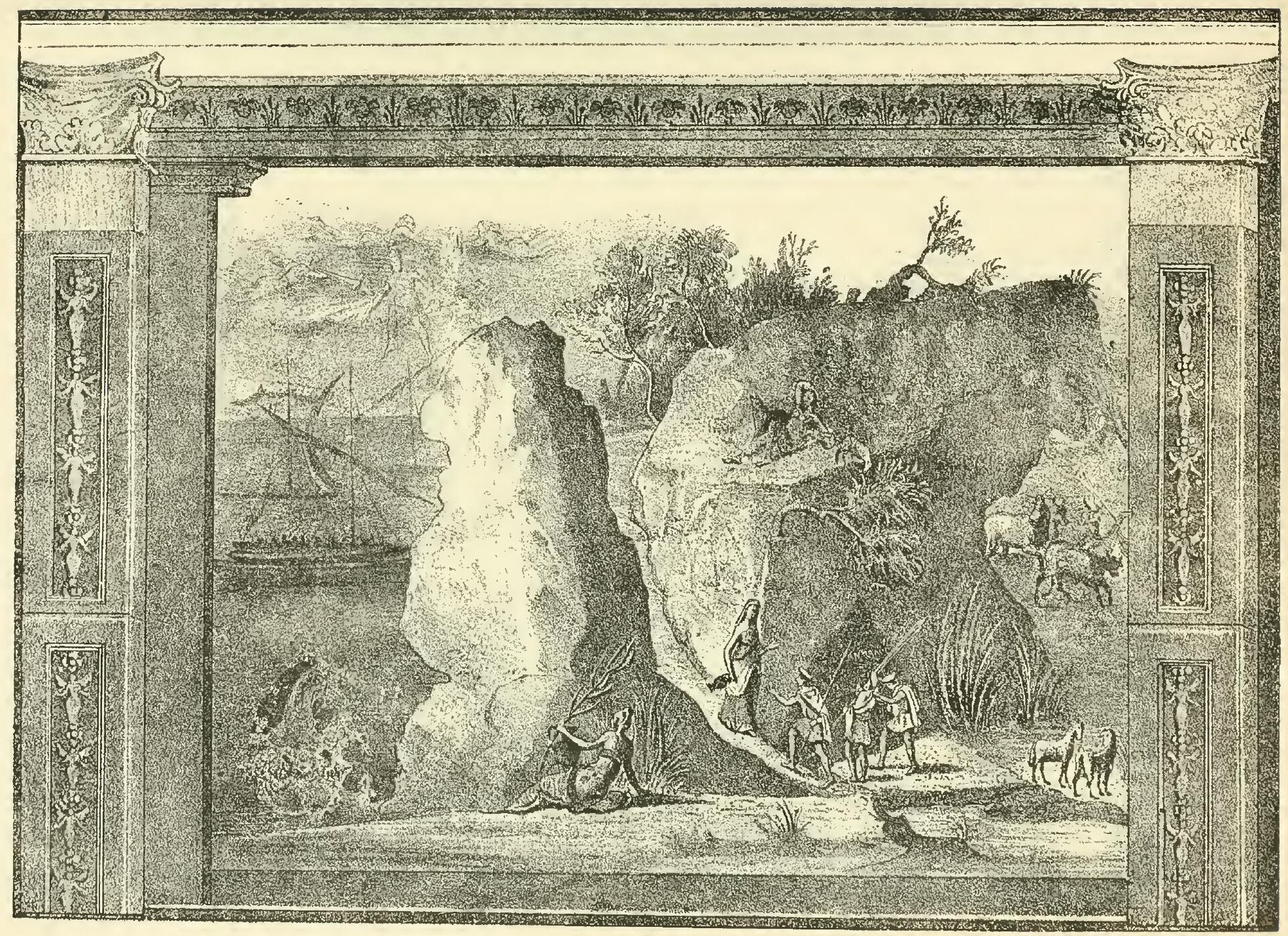
Incontro con la figlia del re dei Lestrigoni
Incontro con la figlia del re dei Lestrigoni. Incisione di pubblico dominio, 1851 (Deutsches Archäologisches Institut / Wikimedia Commons). Ricostruzione: fondo del Comune di Roma.

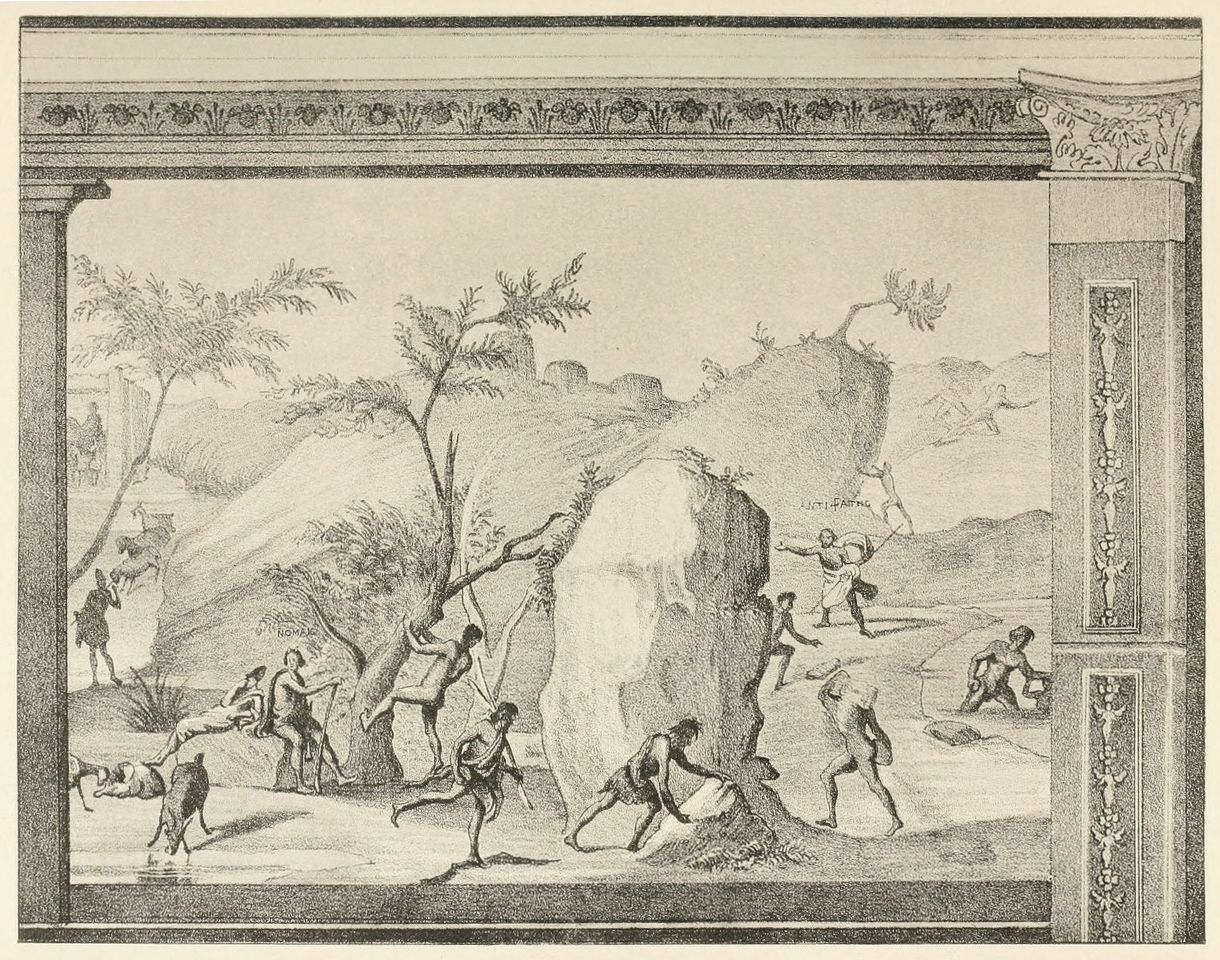
Subito dopo, il paesaggio si popola. Pastori, greggi, rocce, una visuale aerea: è ancora la terra dei Lestrigoni, quella in cui — scrive Omero — la notte è così breve che il pastore che esce all’alba incontra quello che rientra. La tecnica, quasi «impressionistica» nei cespugli e nel cielo, è quella che rese famoso il ciclo già nel 1849. Parte di questa fascia stava ancora sul lato comunale o sulla soglia del confine: è il tratto in cui ogni attribuzione al centimetro sarebbe presuntuosa.

Quadro I nella Sala delle Nozze Aldobrandini: incontro e paesaggio dei Lestrigoni
Quadro I nella Sala delle Nozze Aldobrandini: incontro e paesaggio dei Lestrigoni. Foto MumblerJamie, 2017, licenza CC BY-SA 2.0 (Wikimedia Commons / Flickr). Ricostruzione: fondo comunale / zona di confine.
Stesso tratto in incisione di pubblico dominio, 1851 (DAI / Wikimedia Commons)
Stesso tratto in incisione di pubblico dominio, 1851 (DAI / Wikimedia Commons). Antifate e i Lestrigoni nel paesaggio. Ricostruzione: fondo comunale / confine.

7. Le scene sul fondo di Filippo Bennicelli

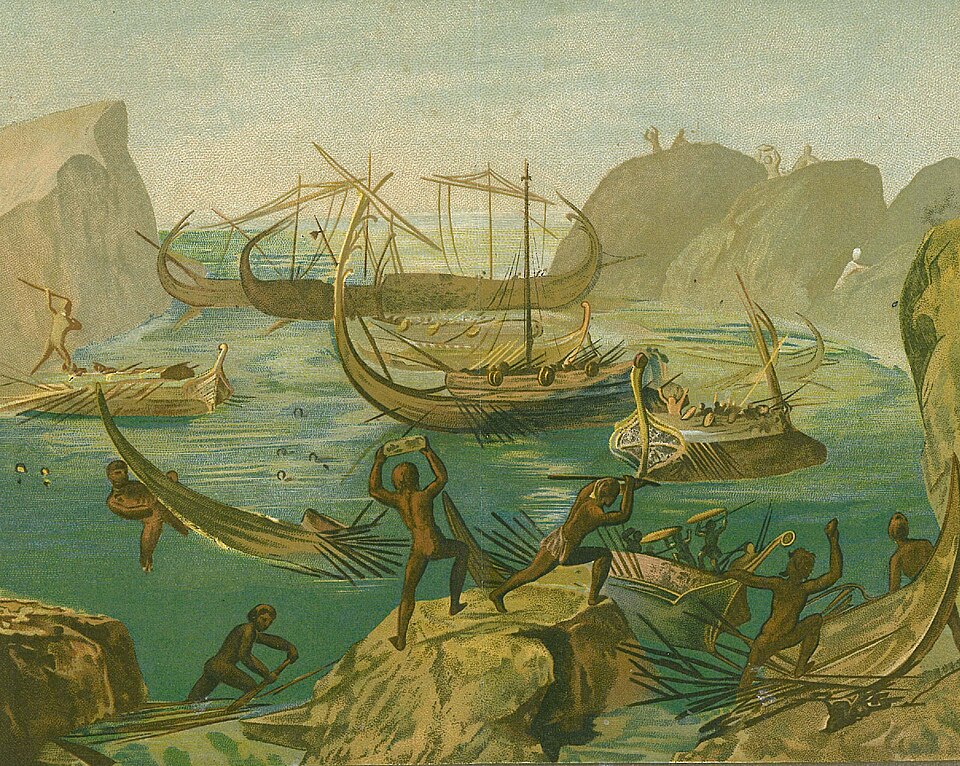
Dal quinto riquadro, secondo la numerazione delle carte contemporanee, lo scavo entra certamente sotto la casa di Filippo Bennicelli. Qui il racconto accelera e si fa carneficina: i Lestrigoni, giganti antropofagi, scagliano massi sulle navi greche e affondano undici delle dodici navi. È il cuore visivo del ciclo, e sta sul suolo privato.
I Lestrigoni distruggono la flotta
I Lestrigoni distruggono la flotta. Foto MumblerJamie, 2017, CC BY-SA 2.0 (Wikimedia Commons / Flickr). Ricostruzione: quota proprietà Filippo Bennicelli. Licenza di scavo: ottobre 1849.
La stessa scena in cromolitografia di pubblico dominio (Wikimedia Commons, «Odysseus bei den Laestrygonen»)
La stessa scena in cromolitografia di pubblico dominio (Wikimedia Commons, «Odysseus bei den Laestrygonen»). Utile a leggere i dettagli delle navi senza usare foto protette dei Musei Vaticani.

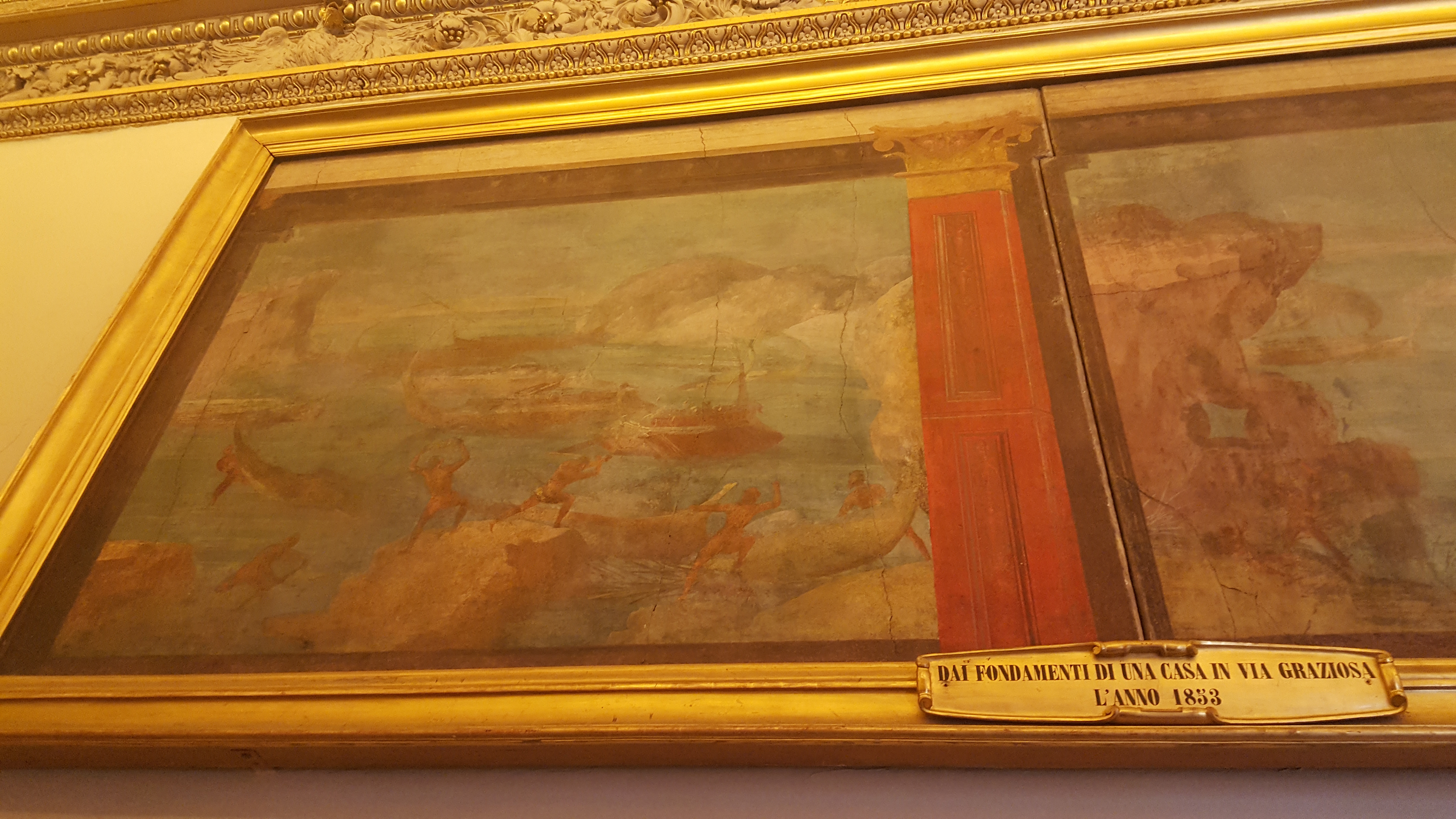
Segue la rotta della sola nave salvata verso Eea, poi la reggia di Circe. Il quadro oggi visibile in cornice dorata, con la didascalia ottocentesca «Dai fondamenti di una casa in via Graziosa l’anno 1853», mostra a sinistra l’architettura della reggia e a destra il paesaggio. È uno dei due grandi rettangoli nati dal ricongiungimento a coppie. Appartiene al tratto che le fonti pongono sotto la proprietà Bennicelli.
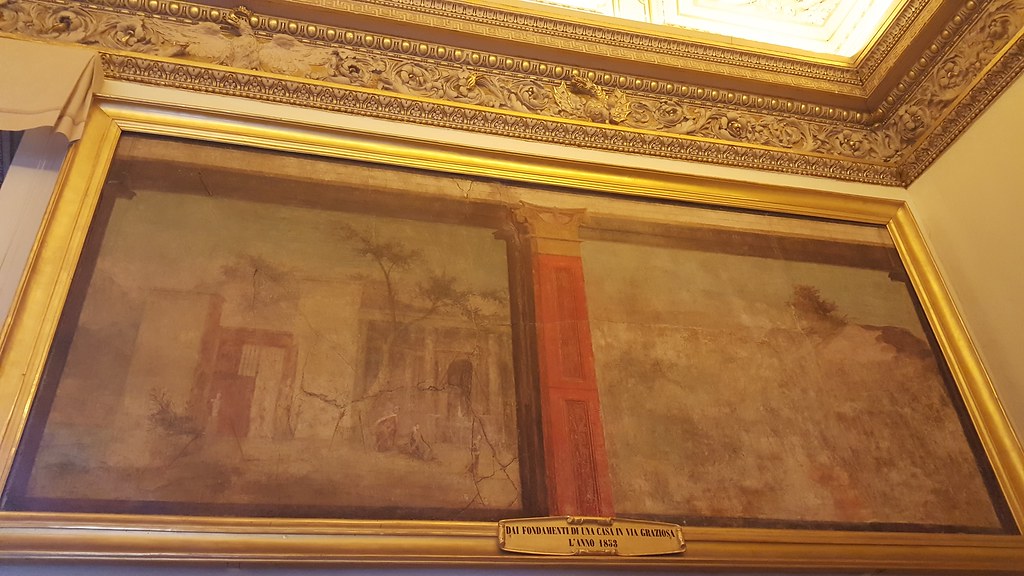
La sola nave di Ulisse fa rotta verso Eea / Circe
La sola nave di Ulisse fa rotta verso Eea / Circe. Targa: «Dai fondamenti di una casa in via Graziosa l’anno 1853». Foto MumblerJamie, 2017, CC BY-SA 2.0. Ricostruzione: fondo del sig. Filippo Bennicelli.

Chiude il ciclo la Nekyia. Ulisse, consigliato da Circe, evoca i morti per interrogare Tiresia. A sinistra le ombre; a destra Orione, Sisifo, Tizio, le Danaidi. È la parte più rara sul piano iconografico: dell’antichità pittorica della Nekyia sappiamo soprattutto per via letteraria (la Lesche di Delfi di Polignoto). Trovarla dipinta su una parete romana del I secolo a.C. fu, già nel 1849, un avvenimento europeo. E stava sotto la casa di Filippo Bennicelli, essendo dunque al ritrovamento di proprietà di quest’ultimo.
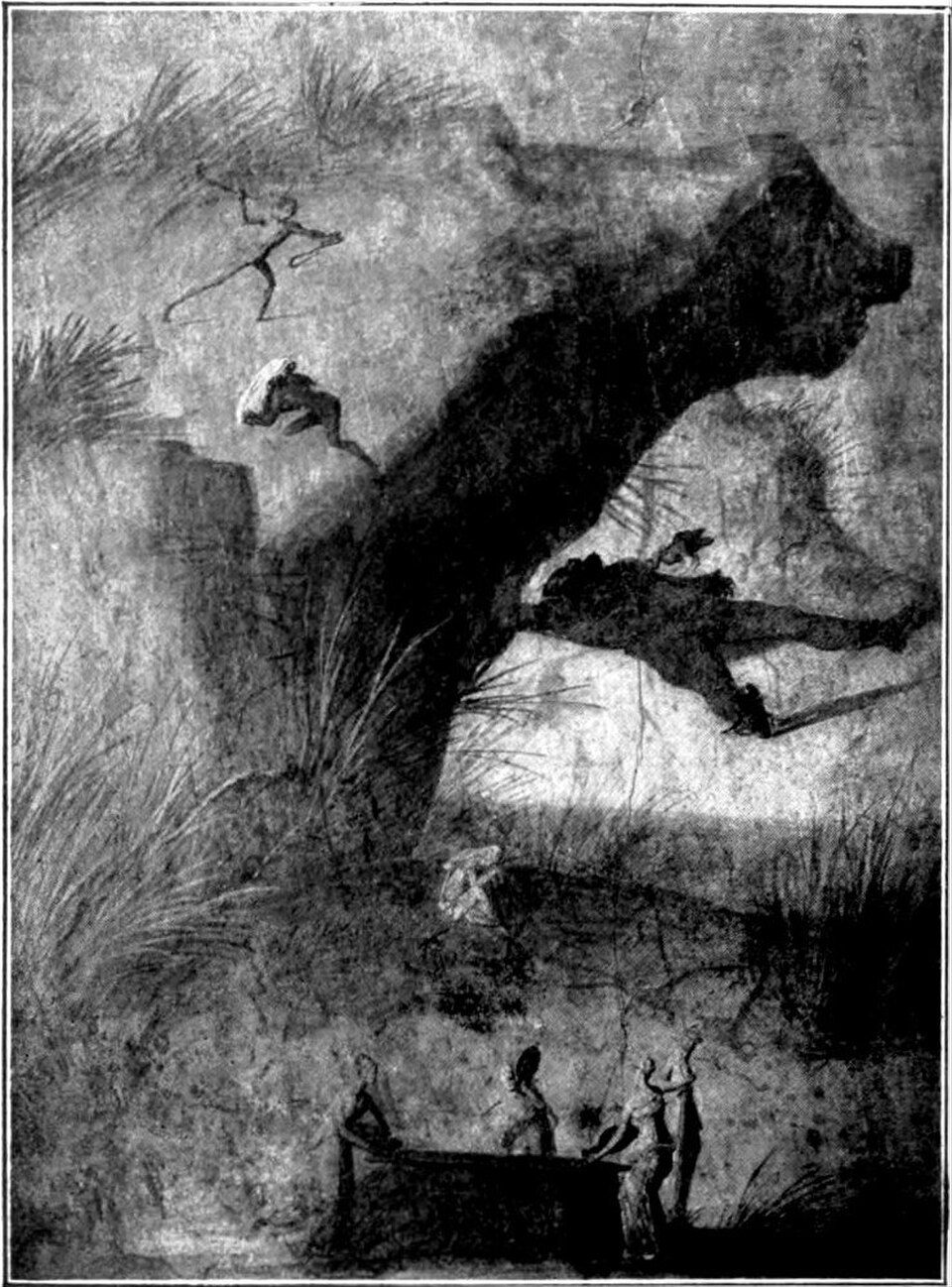
Nekyia: le ombre e le Danaidi
Nekyia: le ombre e le Danaidi. Fotografia Sansaini pubblicata nell’Encyclopædia Britannica, 11ª ed., 1911, «Roman Art», tav. V — pubblico dominio. Ricostruzione: fondo del sig. Filippo Bennicelli.

8. Perché la donazione al Papa chiuse l’accordo

Il Comune poteva acquistare, e di fatto acquistò. Ma non poteva trattare Filippo Bennicelli come un venditore qualunque. Senza il suo consenso la sequenza si spezzava: pochi pannelli pubblici, il resto in una casa privata, con l’incubo della dispersione. Per il proprietario, viceversa, tenere «in salotto» un fregio già famoso nel 1849-50 era giuridicamente fragile e politicamente impraticabile. Lo Stato pontificio, tornato a Roma con Pio IX nell’aprile 1850, aveva ogni interesse a far entrare un ciclo tanto prezioso nelle collezioni papali.

La soluzione che chiuse il cerchio fu questa. Il Comune sborsò la somma necessaria ad acquisire legalmente i reperti. Filippo Bennicelli, titolare della parte preponderante, accettò di uscire dalla “comproprietà di fatto” a condizione che l’intero ciclo fosse offerto al pontefice.

Il 2 gennaio 1851 i pannelli vennero donati ufficialmente a Pio IX. Fu il papa a destinarli alla Biblioteca Apostolica Vaticana.

Questa donazione non è, nelle carte pubbliche, un capriccio devoto né un semplice regalo del Municipio. È l’esito della trattativa. Filippo Bennicelli non «regalò gli affreschi» come si regala un oggetto di casa. Chiese — ed ottenne — che il passaggio di proprietà si concludesse in forma di donazione al papa: unica formula che, nel 1850-51, teneva insieme tre esigenze vere. La prima, la sua: riconoscimento del titolo sulla quota rinvenuta sotto il proprio suolo. La seconda, del Comune: uscire da una spesa pubblica controversa con un atto di munificenza verso il pontefice da poco rientrato. La terza, della Santa Sede: incorporare un unicum della pittura repubblicana senza apparire espropriatrice.

Non risulta, e va detto, un atto notarile pubblicato in cui Filippo Bennicelli detti parola per parola quella clausola. Risulta invece una sequenza documentata di chiara intelligibilità: proprietà spezzata; licenza privata del 1849; acquisto comunale; donazione al papa il 2 gennaio 1851; destinazione immediata alle raccolte vaticane. Lo schema è quello tipico dello Stato della Chiesa per i capolavori.

In questo schema Filippo Bennicelli è il contraente che, pur anche a malincuore, rinuncia ad una proprietà prestigiosa fortemente vincolata, rimarcando la propria riconosciuta devozione al Papa, garantendo al ciclo un destino unitario invece della spezzatura.

9. Che cosa Bennicelli non poteva fare — e che cosa fece

L’Editto Pacca non toglieva a Filippo Bennicelli automaticamente la proprietà della quota trovata sul suo fondo. I scomparti sotto la sua casa non erano «già dello Stato».

Filippo Bennicelli, al contempo, non poteva tenerli, staccarli o venderli a piacere. Doveva dichiararli, accettare il controllo, subire la prelazione, rinunciare all’esportazione.

Un rifiuto frontale, su un ciclo già illustrato e discusso nel 1849-50, sarebbe stato politicamente micidiale nello Stato della Chiesa appena restaurato.

Quello che avvenne sta in questo intervallo. Filippo Bennicelli non si sottrasse alla denuncia. Non disperse i pannelli. Al contrario usò la propria influente posizione per far riprendere gli scavi con denaro pubblico quando il cantiere era fermo e gli affreschi all’aperto. Accettò, in detta prospettiva, l’acquisto comunale. Pose, come condizione di chiusura, che l’insieme andasse al Papa: non in una collezione privata, non spezzato tra Campidoglio e Palazzo Bennicelli, ma in un luogo da cui non sarebbe più uscito. Il 2 gennaio 1851 quella implicita condizione divenne atto.

Dopo il 1909 la risposta sarebbe stata più secca: proprietà statale dei rinvenimenti nel sottosuolo. Nel 1848-51 il regime era di maggior riguardo nei confronti del proprietario del fondo.

Proprietà privata possibile, già fortemente limitata per i capolavori. Bennicelli si mosse dentro quel regime senza farlo saltare, e ne trasse l’unico esito che, con merito per i posteri, teneva insieme il ciclo.

10. Il valore, oggi

Non esiste un prezzo di mercato, inestimabile. Gli affreschi sono beni inalienabili delle raccolte vaticane. Il loro valore sta altrove: sono uno dei pochissimi cicli di pittura paesaggistica tardo-repubblicana, con una fedeltà rara al testo omerico e con una concezione dello spazio che anticipa, per via tutta antica, la pittura di paesaggio moderna. I ritocchi di Ciuli restano un problema filologico; non cancellano il fatto che, senza lo stacco del 1849-50 perorato da Filippo Bennicelli e senza l’accordo che portò i pannelli in Vaticano, oggi parleremmo di un fregio perduto sotto via Cavour.

La donazione del 2 gennaio 1851, letta così, smette di essere «misteriosa ragione» e torna quello che fu: la clausola politica di un proprietario che aveva titolo sulla parte maggiore del ciclo, e che accettò di cederlo soltanto se il Comune lo avesse consegnato al pontefice. Non è agiografia.

È il modo più aderente ai fatti per dire chi tenne insieme gli otto pannelli quando Roma, tra Repubblica e Restaurazione, poteva altrettanto facilmente perderli.

Fonti

  • Musei Vaticani, scheda «Ciclo con scene dell’Odissea da via Graziosa»: rinvenimento 7 aprile 1848, donazione a Pio IX 2 gennaio 1851, otto riquadri riuniti in quattro quadri, datazione anteriore al 46 a.C.
  • The Museum of Classical Antiquities, vol. II: resoconto contemporaneo dello scavo; muro dalla Casa del Comune alla casa di Filippo Bennicelli; licenza ministeriale dell’ottobre 1849 per il tratto privato.
  • Pietro Matranga, La città di Lamo…, Roma 1852: prima monografia, con appendice sul sito dello scavo.
  • Anna Gallina, Le pitture con paesaggi dell’Odissea dall’Esquilino, Studi Miscellanei 6, 1964.
  • Ralf Biering, Die Odysseefresken vom Esquilin, 1995; Filippo Coarelli, The Odyssey frescos of the Via Graziosa, PBSR 66, 1998.
  • Editto Pacca 7 aprile 1820 e giurisprudenza successiva (fino alla Corte d’appello di Roma, 21 aprile 1876) sul titolo del proprietario del fondo.
  • Biografie dei consiglieri comunali di Roma, voce Filippo Bennicelli (n. 1813).

Diritti e licenze

Il testo di questa ricostruzione è originale. Le fonti sono citate in forma breve (schede museali, resoconti di scavo, monografie, norme). Non si riproducono brani sostanziali di opere protette: si riassumono i fatti.

Gli affreschi antichi (metà del I secolo a.C.) sono opera di autore ignoto deceduto da molti secoli: il dipinto in sé è in pubblico dominio. Diverso è il diritto sulle fotografie moderne. Per questo documento non si usano lastre ufficiali dei Musei Vaticani né scatti di siti o riviste privi di licenza libera.

Immagini impiegate, con la licenza che le rende lecite:

  • Incisioni «Laestrygonians I» e «Laestrygonians II», 1851, Deutsches Archäologisches Institut — pubblico dominio (Wikimedia Commons).
  • Cromolitografia «Odysseus bei den Laestrygonen» — pubblico dominio (Wikimedia Commons).
  • «Odysseus among the Shades», foto Sansaini, Encyclopædia Britannica 11ª ed. (1911) — pubblico dominio.
  • Fotografie dei quadri in cornice nella Sala delle Nozze Aldobrandini: MumblerJamie, 2017, licenza Creative Commons Attribution-ShareAlike 2.0 Generic (CC BY-SA 2.0), via Wikimedia Commons / Flickr. Autore da citare: MumblerJamie. Testo della licenza: https://creativecommons.org/licenses/by-sa/2.0/

Chi riutilizza le sole foto CC BY-SA 2.0 deve a sua volta attribuire l’autore e rilasciare l’adattamento della fotografia con la stessa licenza. Il testo storico di questo fascicolo non è sottoposto a quella licenza: resta un testo originale, liberamente citabile con menzione della ricostruzione.

Questa edizione non sostituisce la visione diretta dei quattro quadri in Vaticano e non è una pubblicazione ufficiale dei Musei Vaticani.

The landscapes of the Odyssey of Via Graziosa, once owned by Filippo Bennicelli

Discovery, divided ownership, negotiations with the Municipality and donation to Pius IX (1848–1851)

1. The discovery of 7 April 1848

On 7 April 1848, while demolition and rebuilding were under way on the Esquiline, in a Via Graziosa destined to disappear beneath today’s Via Cavour, workmen struck a wall in opus reticulatum. It was the facing of a portico of a late-Republican domus overlooking the Vicus Patricius. In the upper band of the wall, about four metres above the floor, ran a landscape frieze with episodes from Books X-XII of the Odyssey: the Ulixis errationes per topia of which Vitruvius speaks.

The date accepted by the Vatican Museums is the middle of the 1st century BC, and in any case before 46 BC. The cycle belongs to the Second Style: an illusionistic portico with painted pillars “breaks through” the wall and arranges on it, in sequence, landscapes with small figures and names inscribed in Greek. It is not a schoolbook illustration of Homer. It is a theatre of landscape, in which the hero is small and the world is large.

The contemporary excavation reports — in particular the English account published in the Museum of Classical Antiquities — are explicit on a point that decides the whole subsequent story: the painted wall extended «dalla casa del Comune di Roma alla casa del signor Filippo Bennicelli» [“from the house of the Municipality of Rome to the house of Mr Filippo Bennicelli”]. The first panels, partly already ruined, fell on municipal land. The third and fourth lay beneath the dividing walls between public and private property. From the fifth onwards, according to the numbering of those same papers, the frieze passed entirely beneath the private building. The cycle, in short, was not born as a “treasure of the State”.

It was born split by a property boundary.

2. Who Filippo Bennicelli was

Filippo Bennicelli, born in Rome in 1813, was neither a collector nor a professional scholar. He was a shrewd merchant and administrator who, starting from a position of family comfort, managed — thanks to the acumen with which he was among the first to introduce steam-powered mechanisation — to build in the nineteenth century one of the largest fortunes in Rome and its province.

Later municipal biographies describe him as a man versed in economic matters, a city and provincial councillor, stubborn in asserting the rights of the bourgeoisie even when this made him unwelcome.

In 1848-49 the sources describe him as «sergente, grado della Guardia civica, e “cavaliere” [“sergeant, a rank of the Civic Guard, and ‘cavaliere’”], not yet holding the noble title of count that Pius IX would grant him, for himself and his first-born male line, in 1860.

In 1848, then, he was an established property owner who found, beneath his own house, the most extensive and best-preserved part of a frieze destined to become famous throughout Europe.

The way he behaved — a regular licence, the resumption of the excavations with public funds, the refusal to let the cycle be dispersed, the condition attached to the donation to the Pope — is the crux of this story.

3. Papal law: private property, not full freedom

Rome was still governed by the Pacca Edict of 7 April 1820, with its regulations of 1821. That law did not say — as the Italian law of 1909 would — that «le cose scoperte appartengono allo Stato» [“things discovered belong to the State”]. Finds on private land could remain the property of the owner or of whoever excavated under licence. The same edict, however, bound the private owner in a web of obligations.

  1. A permit was required. One could not dig beneath one’s own house without a licence from the Camerlengato / Minister of Fine Arts. Without a licence one risked a fine and the loss of the objects.
  2. Obligation to report. A pictorial cycle of that quality could not remain hidden.
  3. Right of pre-emption and public interest. The Papal State could acquire the most valuable pieces. For exceptional works the practice was negotiation, compensation or “voluntary” surrender under institutional pressure.
  4. Ban on export and control over circulation. Even while remaining the owner, Filippo Bennicelli could not have sold them abroad or dispersed them without clearance.
  5. Nature of the work. As long as the frescoes were on the wall they formed part of the building. Once detached they became movable antiquities, fully subject to the excavation regulations.

Filippo Bennicelli respected this framework. In October 1849, once the most acute phase of the Roman Republic was over, he obtained from the Minister of Fine Arts and Commerce the authorisation to bring to light the panels that lay on his property. With that licence he consolidated a title to the share found beneath his house: a real title, but one already conditioned by the public interest. The papal rule, after all, was clear: monuments found on a property belong to the owner of the property; the Pacca Edict aimed at conservation, not at automatically transferring title to the State.

4. The Republic, the frescoes in the open air, the public funds

The discovery came at the worst possible moment. Pius IX fled to Gaeta on 24 November 1848, thanks in part to the acknowledged support he received from Filippo Bennicelli; the Roman Republic occupied the city in 1849; the excavations were interrupted. The friezes were left exposed in the open air. Damp and neglect threatened to erase what the building site had only just revealed.

Work resumed thanks to Filippo Bennicelli’s initiative. Modern reconstructions — starting with the studies that draw on the excavation papers and on Ralf Biering’s monograph — credit the owner, and his political influence, with securing further public funds to detach the cycle and bring it to safety. The first two panels, those on the municipal side, were detached first; the rest of the sequence was removed in one piece later. The detachment was carried out by Pellegrino Succi. When the cycle passed to the Pope, the restoration was entrusted to Ettore Ciuli, who filled the gaps in tempera: a heavy-handed intervention that saved the scenes but altered the original colour relationships.

Filippo Bennicelli, quite evidently, was the man without whom the cycle, split between two properties and left exposed to the elements in a year of civil war, would not have emerged whole from underground.

5. How the wall was divided: the Municipality and the Bennicelli property

The frieze was cut into eight sections, cutting through the painted false pillars that marked off the scenes. The eight pieces were then rejoined in pairs into four rectangular pictures, today in the Sala delle Nozze Aldobrandini.

A further fragment, with the Sirens, which came to light in 1940 during work on the underground railway beneath Via Cavour, is in Palazzo Massimo: proof that the original frieze was longer than what the works of 1848-50 managed to save.

Two sources must be held together, without forcing them into agreement. The account of 1849-51 says that the first two “pictures” were almost destroyed; the third and fourth, well preserved, lay on the stretch running from the Municipality’s house towards Bennicelli’s and were for a moment destined for the Capitol; from the fifth onwards the excavation passed beneath Bennicelli’s house, under the licence of October 1849.

Modern studies (and the memory of the affair) insist that the first two panels were detached first and that the greater part of the cycle — six sections out of eight, in the most widespread reading — lay on the private land. The two versions do not cancel each other out: both say that the beginning of the sequence, more damaged, lay on the municipal side, and that the narrative heart (the climax of the Laestrygonians, Circe, the Underworld) lay beneath the property of Filippo Bennicelli, and was therefore, at the time of the discovery, his property.

The original site was destroyed. There is therefore no photograph of the wall in situ with the property boundary superimposed. What follows is an honest reconstruction, not a cadastral survey.

Section / present-day picture Subject (Vatican Museums record) Reconstruction of land ownership
Sections 1–2 → part of Picture I Odysseus’s companions meet the daughter of the king of the Laestrygonians; the attack on the ships begins. The first panels were already almost destroyed in 1848. MUNICIPAL LAND. House of the Municipality of Rome. First panels detached. Public title to the land, already subject to the Pacca Edict.
Sections 3–4 → rest of Picture I / beginning of Picture II The attack continues; a transitional zone towards the destruction of the fleet. The sources of 1851 describe the third and fourth “picture” as well preserved and still on the side running from the municipal house towards Bennicelli’s. BOUNDARY ZONE. Attribution uncertain to the centimetre. The exact cut cannot be sworn to. This is the stretch where the wall passed from one property to the other.
Sections 5–6 → Picture II (rest) and Picture III The Laestrygonians destroy the fleet; Odysseus’s only ship sets course for Aeaea. Then: Odysseus in Circe’s palace; the companions changed back from swine into men. FILIPPO BENNICELLI. From the “fifth picture” onwards the contemporary sources place the excavation beneath his house, under the ministerial licence of October 1849.
Sections 7–8 → Picture IV Nekyia: Odysseus meets the shades of the dead; then Orion, Sisyphus, Tityos and the Danaids. FILIPPO BENNICELLI. The cycle closes on the private land. An integral part of the title on which the negotiations with the Municipality began.

Overall reading, with all the caveats: of the four pictures visible today, the beginning of the sequence (Laestrygonians: meeting and first attack) lay on the municipal land; the central and final body of the story (destruction of the fleet, Circe, the Underworld) lay on the Bennicelli land. In terms of the eight sections, the private share is the majority of the cycle — in the reconstruction most consistent with the family’s memory and with the two-stage detachment, six sections out of eight. It remains true that neither owner could treat the panels like a piece of household furniture.

6. The scenes on the Municipality’s land

The frieze begins with the landing in the land of the Laestrygonians. Odysseus’s companions, still unaware, meet the king’s daughter. The Greek names scratched into the plaster (Trachio, Anchialo and the others) are the sign of a learned Homeric culture, intended for patrons who read Homer in the original. This is the part of the wall that the sources place beneath the Municipality’s house: the first to emerge, the first to be detached, and also the most worn by time and by the building works.

Meeting with the daughter of the king of the Laestrygonians
Meeting with the daughter of the king of the Laestrygonians. Public-domain engraving, 1851 (Deutsches Archäologisches Institut / Wikimedia Commons). Reconstruction: land of the Municipality of Rome.

Immediately afterwards, the landscape fills with life. Shepherds, flocks, rocks, an aerial view: this is still the land of the Laestrygonians, where — Homer writes — the night is so short that the shepherd going out at dawn meets the one coming home. The technique, almost “impressionistic” in the bushes and the sky, is what made the cycle famous as early as 1849. Part of this band still lay on the municipal side or on the threshold of the boundary: it is the stretch where any attribution to the centimetre would be presumptuous.

Picture I in the Sala delle Nozze Aldobrandini: meeting and landscape of the Laestrygonians
Picture I in the Sala delle Nozze Aldobrandini: meeting and landscape of the Laestrygonians. Photo MumblerJamie, 2017, CC BY-SA 2.0 licence (Wikimedia Commons / Flickr). Reconstruction: municipal land / boundary zone.
The same stretch in a public-domain engraving, 1851 (DAI / Wikimedia Commons)
The same stretch in a public-domain engraving, 1851 (DAI / Wikimedia Commons). Antiphates and the Laestrygonians in the landscape. Reconstruction: municipal land / boundary.

7. The scenes on Filippo Bennicelli’s land

From the fifth panel, according to the numbering of the contemporary papers, the excavation certainly enters beneath Filippo Bennicelli’s house. Here the story accelerates and turns into carnage: the Laestrygonians, man-eating giants, hurl boulders at the Greek ships and sink eleven of the twelve. It is the visual heart of the cycle, and it lay on private ground.

The Laestrygonians destroy the fleet
The Laestrygonians destroy the fleet. Photo MumblerJamie, 2017, CC BY-SA 2.0 (Wikimedia Commons / Flickr). Reconstruction: Filippo Bennicelli’s share of the property. Excavation licence: October 1849.
The same scene in a public-domain chromolithograph (Wikimedia Commons, «Odysseus bei den Laestrygonen»)
The same scene in a public-domain chromolithograph (Wikimedia Commons, «Odysseus bei den Laestrygonen»). Useful for reading the details of the ships without using protected Vatican Museums photographs.

Next comes the course of the only surviving ship towards Aeaea, then Circe’s palace. The picture visible today in a gilded frame, with the nineteenth-century inscription «Dai fondamenti di una casa in via Graziosa l’anno 1853» [“From the foundations of a house in Via Graziosa, in the year 1853”], shows the architecture of the palace on the left and the landscape on the right. It is one of the two large rectangles created by rejoining the sections in pairs. It belongs to the stretch that the sources place beneath the Bennicelli property.

Odysseus’s only ship sets course for Aeaea / Circe
Odysseus’s only ship sets course for Aeaea / Circe. Plaque: «Dai fondamenti di una casa in via Graziosa l’anno 1853». Photo MumblerJamie, 2017, CC BY-SA 2.0. Reconstruction: land of Mr Filippo Bennicelli.

The cycle closes with the Nekyia. Odysseus, advised by Circe, summons the dead to question Tiresias. On the left the shades; on the right Orion, Sisyphus, Tityos, the Danaids. It is the rarest part iconographically: of the Nekyia in ancient painting we know mainly through literature (Polygnotus’s Lesche at Delphi). To find it painted on a Roman wall of the 1st century BC was, as early as 1849, a European event. And it lay beneath Filippo Bennicelli’s house, and was therefore, at the time of the discovery, his property.

Nekyia: the shades and the Danaids
Nekyia: the shades and the Danaids. Sansaini photograph published in the Encyclopædia Britannica, 11th ed., 1911, «Roman Art», pl. V — public domain. Reconstruction: land of Mr Filippo Bennicelli.

8. Why the donation to the Pope sealed the agreement

The Municipality could buy, and in fact did buy. But it could not treat Filippo Bennicelli like any ordinary seller. Without his consent the sequence would be broken: a few public panels, the rest in a private house, with the nightmare of dispersal. For the owner, conversely, keeping “in the drawing room” a frieze already famous in 1849-50 was legally fragile and politically impracticable. The Papal State, back in Rome with Pius IX in April 1850, had every interest in bringing so precious a cycle into the papal collections.

The solution that closed the circle was this. The Municipality paid out the sum needed to acquire the finds legally. Filippo Bennicelli, holder of the larger part, agreed to give up the “de facto co-ownership” on condition that the entire cycle be offered to the Pontiff.

On 2 January 1851 the panels were officially donated to Pius IX. It was the Pope who assigned them to the Vatican Apostolic Library.

This donation is not, in the public records, a devout whim or a simple gift from the Municipality. It is the outcome of the negotiation. Filippo Bennicelli did not “give away the frescoes” as one gives away a household object. He asked — and obtained — that the transfer of ownership be concluded in the form of a donation to the Pope: the only formula that, in 1850-51, reconciled three real needs. The first was his own: recognition of his title to the share found beneath his land. The second was the Municipality’s: to emerge from a controversial public expenditure with an act of munificence towards the recently returned Pontiff. The third was the Holy See’s: to incorporate a unique work of Republican painting without appearing to expropriate it.

There is no published notarial deed, it must be said, in which Filippo Bennicelli dictates that clause word for word. There is, however, a documented sequence of clear intelligibility: divided ownership; private licence of 1849; municipal purchase; donation to the Pope on 2 January 1851; immediate assignment to the Vatican collections. The pattern is the one typically followed by the Papal State for masterpieces.

In this pattern Filippo Bennicelli is the party who, even if reluctantly, gives up a prestigious and heavily restricted property, underlining his acknowledged devotion to the Pope and guaranteeing the cycle a unified destiny instead of fragmentation.

9. What Bennicelli could not do — and what he did

The Pacca Edict did not automatically deprive Filippo Bennicelli of ownership of the share found on his land. The sections beneath his house were not “already the State’s”.

At the same time, Filippo Bennicelli could not keep them, detach them or sell them as he pleased. He had to declare them, accept oversight, submit to pre-emption, renounce export.

An outright refusal, concerning a cycle already illustrated and discussed in 1849-50, would have been politically lethal in the newly restored Papal State.

What happened lies within this margin. Filippo Bennicelli did not evade the obligation to report. He did not disperse the panels. On the contrary, he used his influential position to have the excavations resumed with public money when the works had stopped and the frescoes lay exposed. In that perspective, he accepted the municipal purchase. As the condition for closing the deal, he required that the whole go to the Pope: not into a private collection, not split between the Capitol and Palazzo Bennicelli, but to a place from which it would never leave again. On 2 January 1851 that implicit condition became a formal act.

After 1909 the answer would have been blunter: State ownership of finds in the subsoil. In 1848-51 the regime showed greater regard for the owner of the land.

Private ownership was possible, but already heavily restricted for masterpieces. Bennicelli moved within that regime without breaking it, and drew from it the only outcome that, to the benefit of posterity, kept the cycle together.

10. Its value today

There is no market price: it is priceless. The frescoes are inalienable assets of the Vatican collections. Their value lies elsewhere: they are one of the very few cycles of late-Republican landscape painting, with a rare fidelity to the Homeric text and with a conception of space that anticipates, by an entirely ancient route, modern landscape painting. Ciuli’s retouchings remain a philological problem; they do not erase the fact that, without the 1849-50 detachment championed by Filippo Bennicelli and without the agreement that brought the panels to the Vatican, we would today be speaking of a frieze lost beneath Via Cavour.

The donation of 2 January 1851, read in this way, ceases to be a “mysterious reason” and becomes again what it was: the political clause of an owner who held title to the greater part of the cycle, and who agreed to give it up only if the Municipality handed it over to the Pontiff. This is not hagiography.

It is the way that keeps closest to the facts of saying who held the eight panels together when Rome, between Republic and Restoration, could just as easily have lost them.

Sources

  • Vatican Museums, record «Ciclo con scene dell’Odissea da via Graziosa» [“Cycle with scenes from the Odyssey from Via Graziosa”]: discovery 7 April 1848, donation to Pius IX 2 January 1851, eight panels joined into four pictures, dated before 46 BC.
  • The Museum of Classical Antiquities, vol. II: contemporary account of the excavation; wall from the Municipality’s House to the house of Filippo Bennicelli; ministerial licence of October 1849 for the private stretch.
  • Pietro Matranga, La città di Lamo…, Rome 1852: first monograph, with an appendix on the excavation site.
  • Anna Gallina, Le pitture con paesaggi dell’Odissea dall’Esquilino, Studi Miscellanei 6, 1964.
  • Ralf Biering, Die Odysseefresken vom Esquilin, 1995; Filippo Coarelli, The Odyssey frescos of the Via Graziosa, PBSR 66, 1998.
  • Pacca Edict of 7 April 1820 and subsequent case law (up to the Rome Court of Appeal, 21 April 1876) on the title of the landowner.
  • Biographies of the city councillors of Rome, entry Filippo Bennicelli (b. 1813).

Rights and licences

The text of this reconstruction is original. Sources are cited in short form (museum records, excavation reports, monographs, laws). No substantial passages of protected works are reproduced: the facts are summarised.

The ancient frescoes (mid-1st century BC) are the work of an unknown artist who died many centuries ago: the painting itself is in the public domain. The rights in modern photographs are a different matter. For this document no official Vatican Museums plates are used, nor shots from websites or magazines without a free licence.

Images used, with the licence that makes their use lawful:

  • Engravings «Laestrygonians I» and «Laestrygonians II», 1851, Deutsches Archäologisches Institut — public domain (Wikimedia Commons).
  • Chromolithograph «Odysseus bei den Laestrygonen» — public domain (Wikimedia Commons).
  • «Odysseus among the Shades», photo Sansaini, Encyclopædia Britannica 11th ed. (1911) — public domain.
  • Photographs of the framed pictures in the Sala delle Nozze Aldobrandini: MumblerJamie, 2017, Creative Commons Attribution-ShareAlike 2.0 Generic licence (CC BY-SA 2.0), via Wikimedia Commons / Flickr. Author to be credited: MumblerJamie. Licence text: https://creativecommons.org/licenses/by-sa/2.0/

Anyone reusing the CC BY-SA 2.0 photos alone must in turn credit the author and release their adaptation of the photograph under the same licence. The historical text of this booklet is not subject to that licence: it remains an original text, freely quotable with acknowledgement of the reconstruction.

This edition is no substitute for seeing the four pictures in the Vatican in person and is not an official publication of the Vatican Museums.